
What is GEO? Generative engine optimization
What is GEO Generative Engine Optimization? It is a modern approach that helps businesses improve visibility in AI-powered search engines. As AI-powered tools become common, users now expect direct answers rather than just a list of links.
In the growing digital landscape of India, businesses must adapt to stay visible. Generative Engine Optimization helps improve how content is discovered, understood, and cited within AI-driven search results. By understanding these new systems, companies can ensure their content remains relevant and helpful to local users.
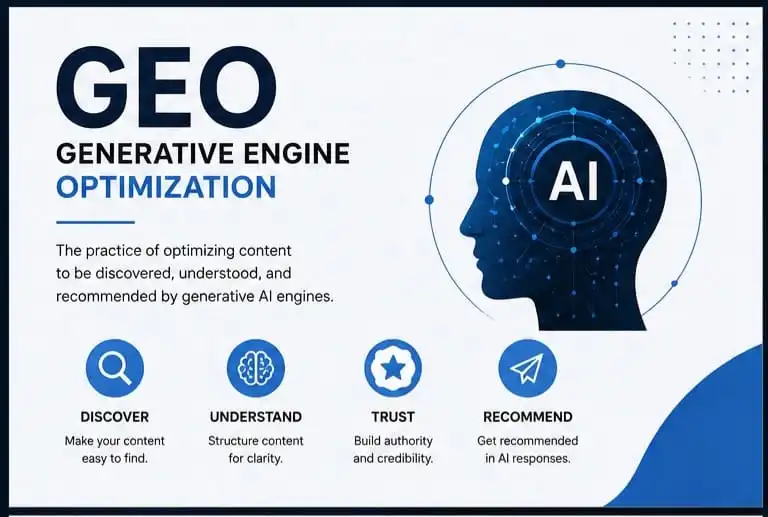
What is GEO Generative Engine Optimization? It refers to the practice of optimizing content so AI-powered search engines can discover, understand, and cite it in generated responses.
This article explores how these systems function and why they matter for your online presence. We will provide actionable strategies to help your organization thrive in this new era of discovery. Let’s dive into the future of search together.
This article explores how these systems function and why they matter for your online presence. We will provide actionable strategies to help your organization thrive in this new era of discovery. Let’s dive into the future of search together.
Key Takeaways
- AI search is shifting from link-based results to direct, conversational answers.
- Understanding new search patterns is vital for maintaining brand visibility in India.
- Content must prioritize accuracy and user intent to rank well in AI models.
- Adapting your strategy now provides a competitive edge in the digital market.
- Success requires a blend of traditional SEO and modern AI-focused techniques.
What is GEO? Generative engine optimization
Navigating the landscape of AI search requires a fresh approach to how we build content. Generative engine optimization, or GEO, is the practice of improving a brand’s likelihood of being understood, referenced, and cited by modern AI search engines. Unlike older methods, this strategy focuses on providing clear, authoritative answers that machines can easily synthesize into conversational responses.
How generative engine optimization differs from traditional SEO
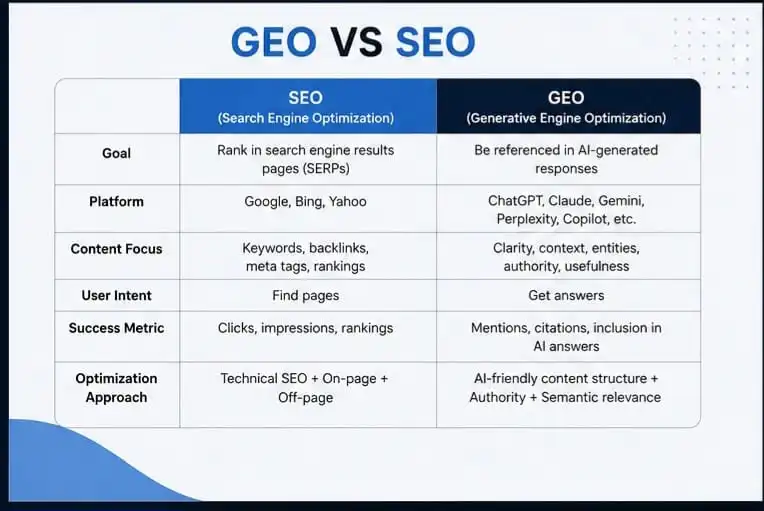
When comparing GEO vs SEO, the primary difference lies in the goal of the output. Traditional SEO aims to secure a high ranking on a list of blue links to drive clicks to a website. In contrast, GEO focuses on becoming the primary source of information within an AI-generated summary.
Understanding What is GEO Generative Engine Optimization helps businesses adapt their content to this new way people search for and discover information.
“The future of search is not just about ranking; it is about being the trusted voice that the machine chooses to quote.”
While traditional SEO relies heavily on keywords and backlinks, GEO prioritizes topical depth and factual clarity. This shift means that businesses must move beyond simple keyword stuffing to provide comprehensive, expert-led content that answers specific user queries directly.
How AI search engines discover, interpret, and cite content
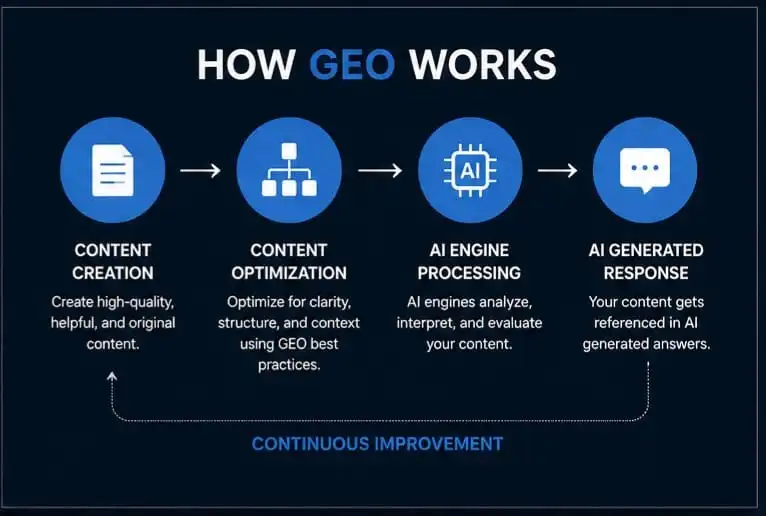
Modern AI search engines function by crawling vast amounts of data to build a coherent understanding of a topic. They do not just index pages; they interpret the relationships between entities, brands, and concepts. Once the system understands your content, it evaluates its credibility before deciding whether to cite your brand as a source.
To understand What is GEO Generative Engine Optimization, businesses must also understand how AI systems evaluate relevance, accuracy, authority, and source accessibility.
To succeed, your content must be structured in a way that is easy for these systems to parse. This involves using clear headings, concise definitions, and logical data structures. When an AI finds your information to be the most accurate and relevant, it will likely feature your brand in its generated response.
Why GEO matters for businesses, publishers, and creators in India
For the vibrant digital ecosystem in India, GEO offers a massive opportunity to capture new audiences. As more users turn to conversational AI for daily tasks, businesses that adapt early will gain a significant competitive edge. Whether you are a local service provider or a national publisher, being cited by an AI can build instant trust with your audience.
- Increased Visibility: Appearing in AI summaries puts your brand at the top of the conversation.
- Brand Authority: Being cited as a source establishes your business as a subject-matter expert.
- Better Engagement: Users who receive helpful answers from AI are more likely to explore the cited sources.
By focusing on GEO vs SEO, Indian creators can ensure their content remains relevant in a rapidly changing digital market. Prioritizing quality and structure will help you stand out as AI search engines continue to evolve and shape the future of the internet.
How Generative Search Changes the Way People Find Answers
Modern search behavior is shifting toward a more conversational and intuitive experience. Users no longer want to click through multiple websites to piece together information on their own. Instead, they prefer systems that do the heavy lifting for them.
From blue-link results to conversational responses
The traditional era of scanning a page of blue links is fading. Generative search now allows users to interact with technology as if they were talking to a knowledgeable assistant. This transition means that search engines now synthesize data from various sources to provide a single, coherent summary.
Why searchers ask longer, more specific questions
As AI capabilities grow, users feel more comfortable asking complex, multi-part questions. People in India, for example, often include specific context about their location or unique needs in their queries. They have learned that precision leads to better results when using advanced AI tools.
- Users seek immediate solutions to daily problems.
- Long-tail queries help AI understand the specific intent behind a search.
- Conversational prompts allow for a more natural flow of information.
How Google AI Overviews, Microsoft Copilot, and ChatGPT Search present information
Major platforms are changing the layout of the search results page to prioritize speed and clarity. AI Overviews, Microsoft Copilot, and ChatGPT Search each use unique algorithms to curate the most relevant content for the user.
Direct answers, follow-up questions, and source citations
These systems provide a direct answer at the top of the page, saving the user significant time. They also suggest follow-up questions to help the user explore a topic more deeply. Crucially, they include clear source citations, which allow users to verify the information provided.
The role of local, current, and trustworthy information
For Indian users, the accuracy of local data is paramount. Whether it is checking the weather in Mumbai or finding a service in Delhi, these AI tools prioritize current and verified facts. Trustworthiness is the foundation of this new search experience, ensuring that users receive reliable guidance every time they interact with the platform.
How AI Systems Choose Sources to Mention
Have you ever wondered why certain websites appear in AI-generated summaries while others are ignored? The process behind these selections is not random; it is a sophisticated evaluation of data quality and user needs. Achieving AI search visibility depends on how well your content aligns with the specific requirements of large language models.
Relevance to the user’s question and search intent
AI systems prioritize content that directly answers the user’s query. If a searcher in India asks about the best local investment strategies, the AI looks for pages that provide clear, actionable advice rather than generic fluff. Alignment with intent is the primary filter that determines if your site makes the cut.
Clear evidence, factual consistency, and topical depth
To earn AI citations, your content must demonstrate high levels of accuracy. AI models are trained to favor sources that provide deep, comprehensive coverage of a topic. When your articles cite original data or expert explanations, you build the trust necessary for the system to reference your brand as a reliable authority.
Entity recognition and connections between people, brands, products, and places
Modern search engines excel at identifying entities. They look for clear relationships between your brand, the products you sell, and the locations you serve. By clearly defining these connections, you help the AI understand exactly who you are and why you are relevant to a specific search query.
Source accessibility, crawlability, and content structure
Even the most brilliant content will fail if the AI cannot read it. A clean, logical structure—using descriptive headings and well-organized paragraphs—is essential for AI search visibility. Ensuring your site is easily crawlable allows these systems to extract the information they need to generate accurate AI citations.
| Signal Category | Primary Goal | Impact on AI |
|---|---|---|
| User Intent | Direct Answer | High |
| Factual Depth | Authority Building | High |
| Entity Mapping | Contextual Clarity | Medium |
| Technical Structure | Accessibility | Critical |
GEO and SEO: What They Share and Where They Differ
Understanding the relationship between traditional search and generative AI is vital for modern digital success. While the landscape is shifting, these two approaches are not enemies. Instead, they work together to help your brand reach the right audience in India and beyond.
Why technical SEO remains the foundation of GEO
Even in an era of conversational AI, technical SEO remains the bedrock of your online presence. If search engines cannot crawl or index your pages, they cannot use your content to build answers. A site that is fast, secure, and well-structured provides the raw data that AI models need to function.
Think of your website as a library. If the books are disorganized or hidden in locked rooms, the librarian cannot find the information to answer a patron’s question. By maintaining clean code and clear site architecture, you ensure that your content is always ready to be discovered.
The answer to What is GEO Generative Engine Optimization becomes clearer when comparing its goals with traditional SEO and organic search visibility.
How rankings and AI citations measure different forms of visibility
Traditional rankings focus on a list of blue links, where your goal is to secure a top spot for a specific query. In contrast, AI citations measure how often an engine trusts your content enough to quote it directly in a summary. Both are valuable, but they serve different stages of the user journey.
- Rankings: Drive direct traffic to your website for further exploration.
- Citations: Build immediate authority and brand recognition within the AI response.
Keyword targeting versus covering complete user questions
Old-school strategies often relied on repeating specific terms to rank. Today, success depends on addressing the underlying search intent behind a query. Users want comprehensive answers that solve their problems, not just pages stuffed with keywords.
To succeed, you must move beyond simple phrases. Focus on creating content that answers the who, what, where, and why of a user’s request. This holistic approach satisfies both the traditional algorithm and the generative model.
Building content for clicks, citations, and brand recall
Your goal should be to create a balanced strategy that captures attention in multiple ways. High-quality content encourages users to click through to your site, while factual depth earns you those coveted AI citations. When you provide consistent value, you also build strong brand recall, which keeps users coming back to you directly.
When a page can appear in search results but not an AI answer
Sometimes, a page might rank well in standard search results but fail to appear in an AI-generated summary. This usually happens when the content lacks the specific, factual depth required to answer a complex question. If your page is too thin or lacks clear, authoritative answers, the AI may choose a more comprehensive source instead.
Creating Content That Generative Engines Can Understand
A robust GEO content strategy focuses on clarity and structure to help AI models process your information effectively. When you organize your pages with the machine in mind, you increase the likelihood of being cited as a primary source. This approach ensures that your brand remains visible in the rapidly changing landscape of generative search.
A key part of What is GEO Generative Engine Optimization is creating clear, structured, and helpful content that generative engines can easily understand and use.
Answering the main question early and directly
Generative engines prioritize speed and accuracy when summarizing topics for users. You should place the most important answer in the first few sentences of your article. This direct approach helps AI systems identify your content as a high-quality, relevant source for specific queries.
Using descriptive headings, concise definitions, and logical sections
Clear headings act as a roadmap for AI crawlers. Use descriptive titles that mirror the questions your audience is asking. By providing concise definitions immediately following these headings, you make it easier for the system to extract and present your information as a factual snippet.
Supporting claims with original data, examples, and expert explanations
AI models value originality and depth. Backing up your statements with unique data or expert insights builds authority. When you provide concrete examples, you help the AI understand the context of your content, which improves your chances of being featured in a response.
Writing natural language around related concepts and entities
Effective content optimization for AI involves using natural language that connects related topics. Instead of focusing on a single keyword, discuss the broader ecosystem of your subject. This helps the engine recognize your brand as an expert entity within your specific industry.
Using tables, lists, comparisons, and step-by-step explanations
Structured formats are highly favored by generative engines because they are easy to parse. Using these elements allows the AI to quickly extract specific details for a user’s query.
- Tables for side-by-side comparisons.
- Numbered lists for sequential processes.
- Bullet points for summarizing key features.
| Feature | Traditional SEO | GEO Strategy |
|---|---|---|
| Primary Goal | Click-through rate | Citations and answers |
| Content Style | Keyword-focused | Entity-focused |
| Format | Long-form text | Structured data/summaries |
Keeping facts, prices, policies, and dates up to date
Accuracy is the foundation of trust for any AI system. If your content contains outdated pricing or expired policies, the engine may stop citing your site. Regularly auditing your pages ensures that your information remains reliable and relevant for users searching in India and beyond.
Technical Practices That Improve AI Search Visibility
Technical optimization is the secret engine behind how AI systems discover and process your website content. While high-quality writing is essential, your site must be technically accessible for AI models to ingest your information effectively. Building a robust technical framework ensures that your brand remains competitive in the evolving landscape of generative search.
Technical accessibility is an important part of What is GEO Generative Engine Optimization, as AI systems need to discover and understand your website content.
Making important content accessible to search crawlers
The first step toward visibility is ensuring your site has excellent crawlability. AI crawlers need a clear path to navigate your pages without encountering dead ends or blocked resources. By simplifying your site architecture, you allow these systems to index your most valuable content efficiently.
Improving page speed, mobile usability, and overall user experience
Search engines prioritize websites that offer a fast, seamless experience on mobile devices. In India, where mobile-first browsing is the standard, slow loading times can significantly hurt your chances of being cited by AI. Optimizing your images and minimizing heavy scripts will keep your site responsive and user-friendly.
Using structured data to clarify articles, businesses, products, and reviews
Implementing structured data SEO is one of the most powerful ways to help AI systems understand your content. By using Schema markup, you provide explicit context about your business, such as operating hours, product prices, and customer ratings. This clarity helps AI models synthesize your data into accurate, conversational answers for users.
“Technical SEO is no longer just about ranking in blue links; it is about providing the structured, clean data that AI models need to build trust and authority.”
— Digital Strategy Expert
Strengthening internal links and creating clear content relationships
Internal linking acts as a roadmap for search engines, showing them how your pages relate to one another. By connecting relevant topics, you help AI systems understand the depth of your expertise on a specific subject. This interconnectedness makes it easier for the engine to verify your information across multiple pages.
Checking robots.txt, indexing directives, canonical tags, and JavaScript rendering
You must regularly audit your technical files to ensure they are not accidentally blocking important content. Proper use of canonical tags prevents duplicate content issues, while ensuring your JavaScript renders correctly is vital for modern AI discovery. Use the following table to track your technical health:
| Technical Element | Primary Goal | Impact on AI |
|---|---|---|
| Robots.txt | Control access | Prevents crawling errors |
| Canonical Tags | Define source | Avoids content dilution |
| JS Rendering | Dynamic display | Ensures content visibility |
| Schema Markup | Data context | Improves citation accuracy |
Building Trust, Authority, and Brand Mentions
Establishing yourself as a reliable source is the most effective way to secure consistent brand mentions in AI search. Modern generative engines do not just look for keywords; they actively hunt for signals of credibility and topical authority. When your brand is recognized as a leader in its field, AI systems are far more likely to cite your content as a primary source of truth.
A complete answer to What is GEO Generative Engine Optimization also includes building trust, authority, and reliable brand information across the web.
Demonstrating first-hand experience and subject-matter expertise
AI models prioritize content that reflects real-world knowledge. You should showcase your unique insights by sharing specific case studies, original research, or hands-on experiences that competitors cannot easily replicate.
This approach proves that your content is grounded in reality rather than theory. By consistently providing deep, expert-led answers, you build the topical authority necessary to stand out in a crowded digital landscape.
Developing reliable author profiles and transparent editorial standards
Transparency is a cornerstone of modern search. Every piece of content should be linked to a verified author with a clear professional background. Providing detailed bios helps AI systems verify the expertise behind the information.
Furthermore, maintaining strict editorial standards ensures that your content remains accurate and unbiased. When users and AI systems see a consistent commitment to quality, they are more likely to trust your brand as a reliable authority.
Strengthening reputation through high-quality references and digital PR
Your reputation is built on the company you keep. Earning mentions from reputable industry publications and trusted news outlets acts as a powerful endorsement for your brand.
“Authenticity is the foundation of digital influence; when you provide genuine value, the search engines will naturally follow your lead.”
— Digital Strategy Expert
Keeping brand information consistent across websites and platforms
Consistency is vital for local and national visibility. Ensure your business name, address, and contact details are identical across all platforms, including social media and industry directories.
This uniformity helps AI systems connect the dots between your various digital assets. It creates a cohesive identity that makes it easier for search engines to validate your business information.
Using reviews, local listings, and customer experiences responsibly
Customer feedback is a goldmine for building trust. Encourage genuine reviews and manage your local listings with care to reflect the true quality of your services.
| Trust Signal | Impact on AI | Action Item |
|---|---|---|
| Author Bios | High | Link to professional profiles |
| Local Reviews | Medium | Respond to feedback daily |
| External Citations | High | Earn links from industry sites |
Why unsupported claims and copied content weaken visibility
AI systems are increasingly adept at identifying low-quality or fabricated information. Making bold, unsupported claims can lead to a loss of trust, which directly harms your brand mentions in AI search.
Always prioritize original, fact-checked content over shortcuts. By avoiding copied material and focusing on unique value, you protect your brand’s long-term reputation and search performance.
Practical GEO Strategies for Indian Businesses
For businesses operating across India, adapting to AI-driven search is no longer optional. As generative engines become the primary way users find information, brands must shift their focus toward providing direct, context-aware answers that resonate with the local audience.
For Indian businesses, What is GEO Generative Engine Optimization involves adapting content to local search intent, language, and customer needs.
Targeting Indian search intent without forcing keywords
Indian users often phrase their queries in a conversational manner, blending English with local linguistic nuances. Instead of stuffing keywords, focus on answering the specific intent behind the search. By providing clear, concise responses to common questions, you increase the likelihood of being cited by AI models.
Creating useful local content for cities, regions, and service areas
Effective local SEO India strategies involve creating content that speaks to the unique needs of different states and cities. Whether you are a service provider in Mumbai or a retailer in Bengaluru, your content should highlight your presence in those specific regions. This helps AI systems associate your brand with relevant geographic locations.
Addressing multilingual and English-language search behavior
India is a diverse market where search behavior varies significantly between urban and rural populations. Implementing a robust multilingual SEO India approach ensures that your brand remains visible to users who prefer searching in their native languages or regional dialects. Understanding these linguistic patterns is essential for building long-term trust with a broader customer base.
Explaining prices, availability, delivery areas, and local regulations clearly
Generative engines prioritize factual accuracy when users ask about logistics or costs. Clearly stating your pricing in Indian Rupees (INR) and defining your delivery zones helps AI systems provide accurate information to potential customers. Always ensure that your content reflects current local regulations to maintain high authority and credibility.
Examples for Indian healthcare, education, finance, travel, and e-commerce brands
- Healthcare: Provide clear, verified information about hospital locations and specialized services.
- Education: Detail course structures, fee transparency, and accreditation status.
- Finance: Explain interest rates and eligibility criteria using simple, jargon-free language.
- Travel: Offer specific itineraries and seasonal travel advice for popular Indian destinations.
- E-commerce: Highlight delivery timelines and return policies tailored to local logistics.
Using Indian examples, measurements, currencies, and customer expectations
To truly connect with your audience, your content must reflect the reality of the Indian market. Use standard Indian measurements, such as square feet for real estate or kilograms for retail, rather than international alternatives. Aligning your content with local customer expectations—such as the preference for cash-on-delivery or specific festive shopping periods—will significantly improve your brand’s relevance in AI-generated responses.
How to Measure and Improve GEO Performance
Understanding how AI engines perceive your brand is the next frontier for digital growth. Because generative search behaves differently than traditional blue-link results, you need a specialized framework for GEO performance measurement. This process helps you identify where your content shines and where it needs refinement.
Businesses learning What is GEO Generative Engine Optimization should also measure how often their content and brand appear in AI-generated search results.
Tracking whether AI platforms mention or cite your brand
The first step is to monitor how often AI models like Google AI Overviews or ChatGPT reference your domain. You should look for direct citations that link back to your site as a primary source of truth. Visibility in these summaries is a strong indicator that your content is considered authoritative by the underlying model.
Monitoring branded prompts and important non-branded questions
You must test how your brand appears when users ask specific questions related to your industry. By tracking both branded and non-branded queries, you gain insight into your AI search rankings across different intent categories. This dual approach ensures you capture both loyal customers and new users searching for solutions.
Comparing citations, referral traffic, impressions, and conversions
Data analysis is vital to understanding the real-world impact of your efforts. Use the following table to organize your key performance indicators:
| Metric | Why It Matters | Goal |
|---|---|---|
| Citations | Validates authority | Increase frequency |
| Referral Traffic | Measures intent | Drive qualified leads |
| Conversions | Shows ROI | Improve bottom line |
Auditing factual accuracy and the context of each mention
It is not enough to simply appear in a response; the context must be accurate and helpful. Regularly audit your mentions to ensure the AI is not hallucinating or misrepresenting your services. Maintaining factual integrity protects your brand reputation and keeps users trusting your content.
Creating a repeatable prompt-testing and content-update process
Establish a monthly routine where you run a set of core industry questions through various AI tools. If the results are outdated or missing your brand, update your source content to be more descriptive and structured. This repeatable process ensures your information remains relevant as AI models evolve.
Setting realistic expectations for changing AI search results
Remember that AI search results are dynamic and can change based on new data or model updates. Do not be discouraged if your AI search rankings fluctuate in the short term. Focus on long-term consistency and providing high-quality, expert-led content that serves the user’s needs effectively.
Common GEO Mistakes and a Sustainable Optimization Plan
Navigating the world of AI search requires a careful balance between machine logic and human needs. While it is tempting to chase every algorithmic trend, focusing solely on automated systems often leads to GEO mistakes that hurt your brand reputation. True success comes from creating content that serves your audience first.
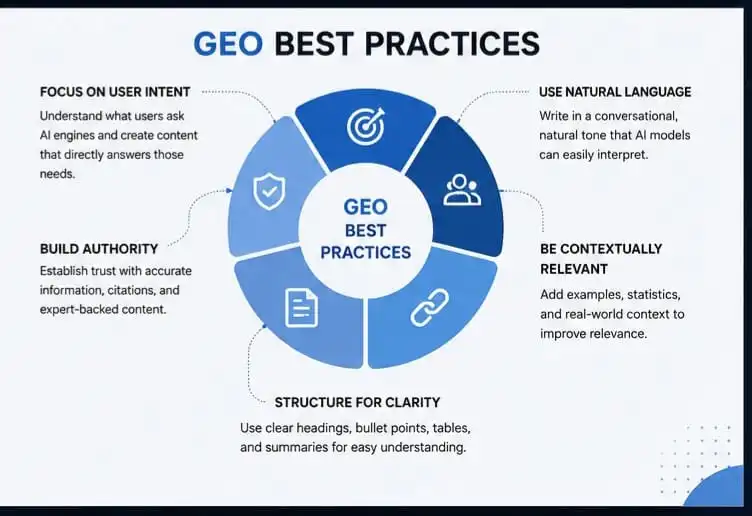
Why writing only for AI can make content less useful to people
When you write exclusively for generative engines, you risk losing the human touch that builds trust. AI models prioritize clarity, but they cannot replicate the empathy or nuance that a real person brings to a topic. If your content feels robotic or overly structured, readers will likely bounce, signaling to search engines that your page lacks value.
Avoiding keyword stuffing, fabricated expertise, and unsupported statistics
One of the most dangerous GEO mistakes involves trying to trick the system with unnatural keyword density. Modern AI models are highly sophisticated and can easily detect when text is manipulated for ranking purposes. Furthermore, relying on fabricated expertise or unverified statistics will quickly erode your authority. Always ensure your claims are backed by credible sources and original research.
Balancing scalable content production with editorial review
Scaling your content output is important, but it should never come at the cost of quality. A sustainable GEO strategy requires a robust editorial process where every piece of content undergoes a human review. This ensures that your brand voice remains consistent and that all information is accurate before it reaches the public.
Building a practical GEO workflow from research to measurement
A structured workflow is the backbone of any long-term success in generative search. By organizing your efforts, you can maintain high standards while adapting to new search behaviors. This approach allows you to stay ahead of the curve without burning out your team.
Researching real questions and identifying content gaps
Start by listening to what your customers are actually asking. Use tools to identify common queries and look for gaps where your competitors are failing to provide clear, helpful answers. Addressing these specific needs is the best way to earn a spot in AI-generated summaries.
Publishing, validating, monitoring, and updating content over time
Your work does not end once you hit publish. You must continuously monitor how AI platforms interpret your content and validate that your answers remain accurate. A sustainable GEO strategy involves regular updates to keep your information fresh, relevant, and aligned with the latest user intent.
Conclusion
What is GEO Generative Engine Optimization? It is an evolving approach that helps businesses improve their visibility in AI-powered search experiences.
Generative search marks a shift in how users interact with information online. By focusing on clarity and authority, you ensure your brand remains a top choice for AI systems like Google AI Overviews or Microsoft Copilot. The primary benefits of GEO include stronger visibility and deeper connections with your audience.
You gain a competitive edge by providing direct answers that satisfy complex user queries. This approach builds trust with both human readers and machine learning models. When you prioritize high-quality, accessible content, you naturally improve your brand representation across the digital landscape.
Start by auditing your current web presence to identify gaps in your information architecture. Small adjustments to your technical structure and content depth yield significant long-term rewards. The benefits of GEO become clear as you track how often your brand appears in AI-generated responses.
Stay committed to a people-first strategy that values accuracy and expert insight. Use performance data to refine your approach and adapt to changing search behaviors. Your journey toward better AI visibility begins with consistent, reliable, and helpful content for every user in India.
FAQ
What is GEO, and how does it differ from traditional SEO?
What is GEO Generative Engine Optimization? It is the practice of optimizing content so AI-driven systems can discover, understand, and cite a brand within generated responses.
How do AI systems like ChatGPT and Microsoft Copilot choose which sources to mention?
These systems look for high-quality signals such as relevance to search intent, entity recognition, and source accessibility. AI models prefer content that provides clear evidence, original data, and a logical structure. They often prioritize brands and creators that demonstrate strong connections between people, products, and places, ensuring the information they synthesize is both trustworthy and current.
Does technical SEO still matter for Generative Engine Optimization?
Absolutely! Technical SEO remains the foundation of GEO. For an AI to cite your website, its crawlers must first be able to access your content. This means maintaining a healthy robots.txt file, ensuring proper JavaScript rendering, and using canonical tags correctly. Additionally, page speed and mobile usability are critical for overall visibility, as these engines prefer sites that offer a seamless user experience.
What are the best content formats for improving visibility in AI search results?
To help generative engines interpret your data, you should use natural language and answer the primary question early and directly. Incorporating structured data, descriptive headings, and tables or lists makes your information much more digestible for AI models. Providing step-by-step explanations and keeping your facts, prices, and policies up to date also increases the likelihood of being featured as a primary source.
How can Indian businesses tailor their GEO strategy for the local market?
For brands in India, it is vital to address multilingual search behavior and local intent. Whether you are in healthcare, education, or e-commerce, your content should reflect Indian currency, local measurements, and specific regional regulations. Creating content that targets cities and service areas across India—while providing clear details on delivery areas and customer expectations—helps AI engines connect your business with local users.
How can I build trust and authority to ensure AI engines cite my brand?
AI systems value E-E-A-T (Experience, Expertise, Authoritativeness, and Trustworthiness). You can strengthen your reputation by developing detailed author profiles, maintaining transparent editorial standards, and earning high-quality references through digital PR. Avoiding unsupported claims or copied content is essential, as these can significantly weaken your visibility in AI-generated answers.
How do I measure the success of my GEO efforts?
Unlike traditional rankings, GEO performance is measured by tracking brand mentions and citations within AI responses. You should regularly monitor branded prompts and important non-branded questions to see how your brand is being described. Key metrics include referral traffic from AI platforms, impressions, and the factual accuracy of the mentions your brand receives.
What are the most common mistakes to avoid in Generative Engine Optimization?
One of the biggest mistakes is writing exclusively for AI while ignoring the human reader. Avoid keyword stuffing, fabricated expertise, and using unsupported statistics. While scaling content is tempting, a lack of editorial review can lead to inaccuracies. Instead, focus on a sustainable workflow that involves researching real questions, identifying content gaps, and consistently updating your information to maintain accuracy.