
AI in SEO
Modern digital marketing is changing rapidly. Many professionals now use AI in SEO to boost search rankings and streamline complex research tasks. This technology helps teams create smarter content while saving valuable time on repetitive data analysis.
AI in SEO is helping businesses combine faster data analysis with human expertise to improve content, technical performance, and organic visibility.
It is important to remember that these tools are meant to support your work, not replace your human expertise. Strategic judgment remains the most vital part of any successful campaign. By balancing machine efficiency with creative insight, you can achieve better results than ever before.
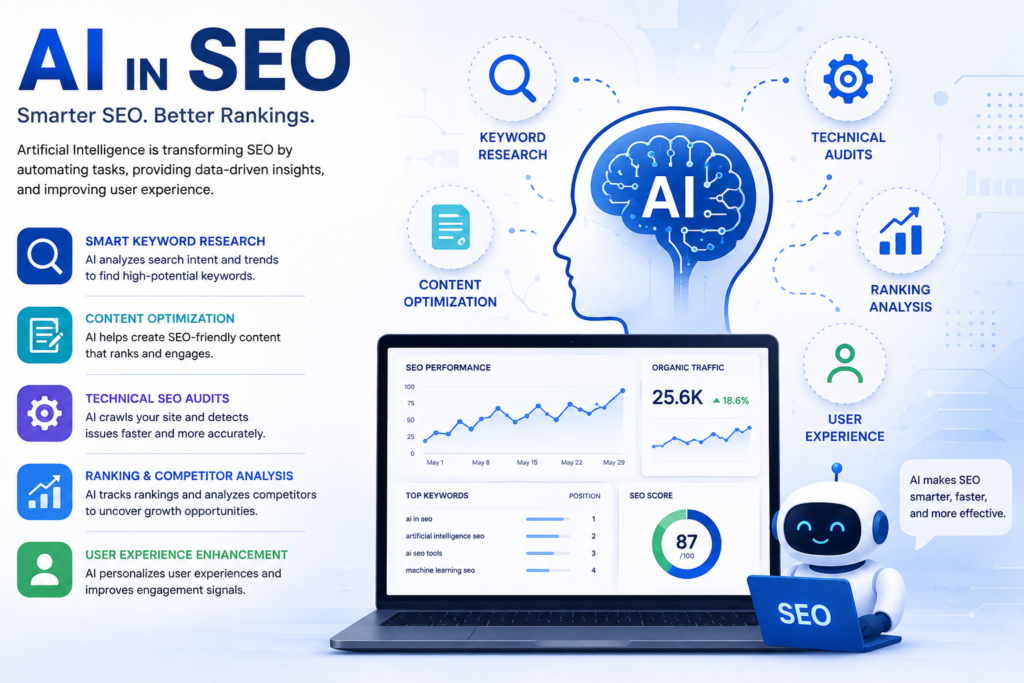
This guide explores the future of search optimization across thirteen detailed sections. We will cover everything from understanding search intent and content production to technical audits, risk management, and building a sustainable workflow. Let’s dive into how AI in SEO can transform your digital strategy today.
Key Takeaways
- Leverage smart tools to improve your search engine rankings.
- Use automation to handle research and content creation tasks.
- Maintain human oversight to ensure high-quality strategic decisions.
- Explore a comprehensive roadmap for modern search success.
- Balance new technology with proven marketing principles.
What AI in SEO Means for Modern Search
Modern search engines are evolving beyond simple keyword matching to understand the true search intent behind every query. In the United States, users expect immediate and relevant answers that go far beyond a list of blue links. This shift requires a more sophisticated approach to how we build and optimize our digital presence.
How Artificial Intelligence Interprets Search Intent
Artificial intelligence has changed the game by analyzing the context and nuance of human language. Instead of just looking for specific words, algorithms now identify the underlying goal of a user. This allows search engines to provide results that match what a person actually needs, whether they are looking to buy, learn, or navigate.
By leveraging AI in SEO, professionals can uncover patterns that were previously invisible. These tools excel at identifying:
- The specific stage of the buyer’s journey for a given query.
- Common questions that users ask when they are researching a topic.
- The type of content—such as video, guides, or product pages—that best satisfies a specific search intent.
Where AI Supports, Rather Than Replaces, SEO Expertise
While technology is powerful, it is not a substitute for human strategy. AI in SEO acts as a high-speed analytical assistant that handles data processing, but it lacks the ability to understand brand values or complex business goals. You remain the pilot who directs the ship, while the software provides the map and weather reports.
Experienced professionals must still provide the final judgment on content quality and prioritization. Relying solely on automation can lead to generic results that fail to resonate with your target audience. The most successful teams use these tools to enhance their productivity while keeping their unique brand voice at the center of every campaign.
Why Businesses Are Adopting AI in SEO
Why are so many companies turning to smart software to manage their online presence? The answer lies in the need for speed and precision in an increasingly crowded digital marketplace. By integrating AI in SEO tools into their daily operations, organizations can handle massive amounts of data that would otherwise take weeks to process manually.
Faster Research and More Efficient Workflows
Modern marketing teams often struggle with repetitive tasks that drain their creative energy. SEO automation allows professionals to bypass tedious data entry and basic site audits, freeing them to focus on high-level strategy. This shift helps teams identify trends and patterns in seconds rather than hours.
When research becomes faster, the entire content production cycle improves. Teams can now generate comprehensive insights about user behavior and search trends with minimal friction. This efficiency ensures that every piece of content is backed by solid data rather than guesswork.
Using AI in SEO makes research and workflow management faster while allowing professionals to focus on strategy and decision-making.
Opportunities to Improve Rankings and Organic Visibility
Beyond simple time savings, these technologies provide a clear path to better search performance. By leveraging advanced algorithms, businesses can uncover hidden opportunities to capture more traffic. SEO automation helps identify specific areas where a website might be underperforming compared to industry standards.
Improving organic visibility is no longer just about luck or intuition. With the right tools, companies can optimize their pages to meet the exact needs of their target audience. This proactive approach leads to higher rankings and a more sustainable growth trajectory over time.
Balancing Automation With Human Judgment
While technology offers incredible power, it should never replace the nuance of human expertise. The most successful brands use AI to support their decisions, not to make them entirely. Human review remains essential to ensure that all output aligns with brand voice and maintains high quality.
Productivity gains should always serve the goal of creating better, more helpful content for users. Relying solely on machines can lead to generic or inaccurate results that fail to resonate with real people. By combining AI SEO tools with human oversight, businesses can achieve the perfect balance of scale and authenticity.
Using AI to Research Keywords and Search Intent
Mastering the art of search intent requires more than just looking at monthly search volume numbers. While traditional tools provide a snapshot of popularity, they often fail to capture the underlying motivation of the user. By integrating AI keyword research into your workflow, you can uncover deeper patterns that reveal exactly what your audience needs.
Finding Topic Ideas Beyond Basic Keyword Volume
Basic volume metrics often hide the most valuable content opportunities. AI tools can analyze vast datasets to identify emerging trends and sub-topics that standard keyword planners might overlook. This process helps you find unique angles that resonate with your specific audience.
Instead of chasing high-volume terms that are already saturated, you can use AI to discover niche topics. These suggestions often highlight question formats and specific pain points that your competitors have ignored. Focusing on these areas allows you to build authority in your space more effectively.
AI in SEO can make keyword research more efficient by identifying search patterns, related topics, and potential content opportunities.
Grouping Related Queries Into Search Intent Categories
Effective keyword clustering is essential for organizing your content strategy. AI can automatically categorize thousands of queries based on whether they are informational, commercial, navigational, or transactional. This structure ensures that every page on your site serves a clear, defined purpose for the user.
By grouping related terms, you can create comprehensive content hubs that satisfy the user’s journey. This approach helps search engines understand the relevance of your site across entire topics rather than just individual keywords. It is a powerful way to improve your overall site architecture.
Identifying Long-Tail and Conversational Searches
The rise of voice search and natural language processing has made long-tail keywords more important than ever. AI excels at identifying these conversational phrases that mimic how people actually speak. These queries often have lower competition but higher conversion rates because they reflect specific user needs.
Checking AI-Generated Keyword Suggestions Against Real Search Data
While AI is a brilliant assistant, it is not infallible. You must always verify AI-generated suggestions against reliable, real-world search data before making final targeting decisions. Keyword clustering is only as good as the data feeding the model.
Always cross-reference your findings with platforms like Google Search Console or third-party SEO tools. This final check ensures that your strategy remains grounded in verifiable search behavior. By combining human judgment with machine efficiency, you create a robust foundation for long-term growth.
Creating Better Content With AI Assistance
Elevating your writing process requires more than just tools; it requires a strategic approach to AI content creation. By treating technology as a collaborative partner, writers can move past the blank page faster and focus on delivering real value to their readers. One of the most practical uses of AI in SEO is improving the content creation process without replacing original human expertise.
Building Useful Content Briefs and Detailed Outlines
Starting a project with a clear roadmap is essential for success. AI tools excel at generating comprehensive content briefs that identify key subtopics and target audience questions before you write a single sentence.
These outlines provide a logical flow that keeps your writing focused. By organizing your thoughts into a structured hierarchy, you ensure that every section serves a specific purpose for the reader.
Improving Clarity, Structure, and Content Readability
True SEO content optimization is an editorial activity that goes far beyond simply inserting keywords. It is about refining your message so that it is easy to scan, understand, and act upon.
AI can help you identify overly complex sentences or repetitive phrasing that might hinder the reader’s experience. By smoothing out these rough edges, you create a more professional and accessible final product.
Generating Examples, Supporting Points, and Content Angles
Sometimes the hardest part of writing is finding a fresh perspective on a familiar topic. AI can suggest unique angles or provide diverse examples that help illustrate your main points more effectively.
These suggestions act as a springboard for your creativity. They allow you to explore different viewpoints and add depth to your arguments without spending hours on manual brainstorming.
Keeping Original Expertise at the Center of Every Draft
While technology is helpful, it cannot replace your unique voice or firsthand experience. SEO content optimization should always be guided by your subject-matter knowledge and critical thinking.
Always verify facts and ensure that the tone aligns with your brand identity. By keeping your human expertise at the center of the process, you ensure that your content remains authentic, trustworthy, and truly useful to your audience.
Optimizing Existing Pages With Artificial Intelligence
Many website owners overlook the goldmine of potential hidden within their older, underperforming pages. By applying on-page SEO strategies through modern technology, you can breathe new life into content that has lost its competitive edge. AI tools act as a force multiplier, allowing you to audit vast amounts of data in seconds rather than hours. AI in SEO can also help businesses identify underperforming pages and prioritize the most valuable optimization opportunities.
Finding Content Gaps and Outdated Information
AI excels at identifying what your content is missing compared to top-ranking competitors. These tools scan your existing articles to detect outdated statistics, broken links, or topics that have evolved since your last update. By highlighting these gaps, AI ensures your SEO content optimization efforts are focused on areas that provide the most value to your readers.
Improving Titles, Headings, Meta Descriptions, and Internal Links
Refining your metadata and structure is a fundamental part of maintaining a healthy site. AI can suggest more compelling titles and meta descriptions that increase click-through rates by aligning better with current user intent. Furthermore, these systems can recommend internal linking opportunities, connecting your older pages to newer, high-authority content to distribute link equity effectively.
Strengthening Pages That Have Declining Organic Traffic
When you notice a dip in traffic, it is often a sign that your content no longer satisfies the current search landscape. AI platforms analyze performance trends to pinpoint exactly why a page is slipping. Whether it is a lack of depth or a shift in how users search for your keywords, AI provides actionable insights to help you reclaim your rankings.
Reviewing AI Recommendations Before Making On-Page Changes
While automation is powerful, it should never replace your editorial judgment. Always compare AI suggestions against your specific brand goals, audience expectations, and conversion data. Context is king, and human oversight ensures that every change remains authentic and helpful to your target audience.
| Optimization Task | Manual Approach | AI-Assisted Approach |
|---|---|---|
| Content Auditing | Time-consuming manual review | Instant gap identification |
| Metadata Updates | Guesswork and testing | Data-driven suggestions |
| Internal Linking | Manual mapping | Automated connection discovery |
| Traffic Recovery | Reactive troubleshooting | Proactive trend analysis |
By combining the speed of AI with your unique expertise, you can master on-page SEO and keep your website performing at its peak. Consistent SEO content optimization is the key to long-term success in the digital space.
Applying AI to Technical SEO
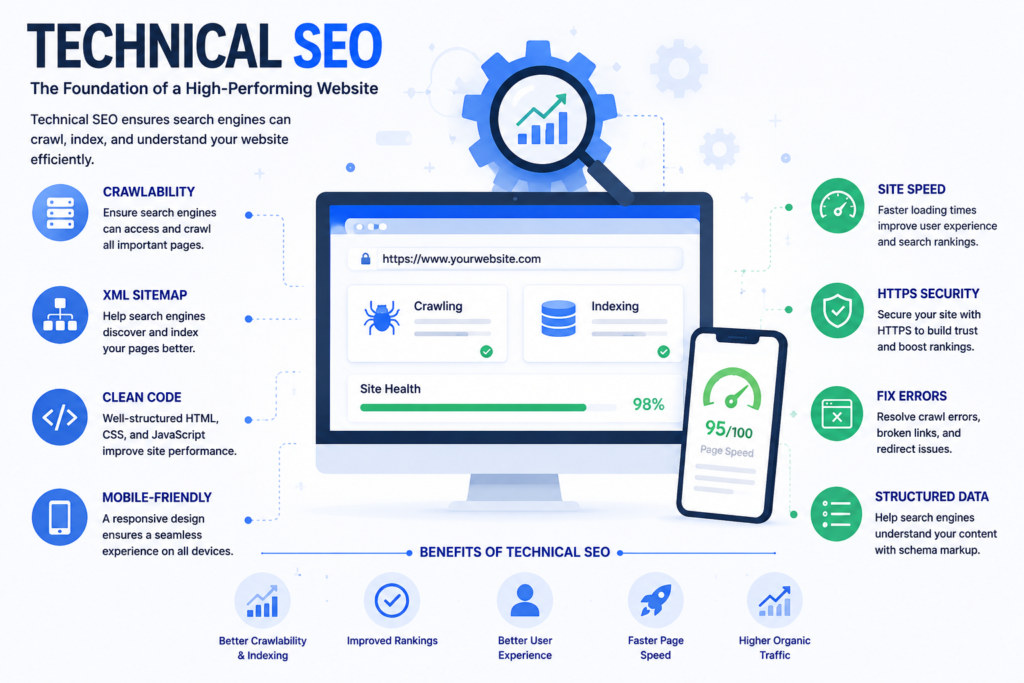
Technical optimization is no longer just a manual chore thanks to the rise of intelligent diagnostic tools. By processing vast amounts of server logs and site data, these systems identify patterns that human auditors might easily miss. This shift allows teams to focus on strategic improvements rather than spending hours hunting for minor errors. Applying AI in SEO to technical audits can help teams detect patterns and prioritize important website issues more efficiently.
Detecting Crawlability, Indexing, and Website Performance Issues
AI-driven platforms excel at monitoring how search engine bots interact with your site. They can quickly flag anomalies in crawl budgets, broken redirect chains, or slow page load times that hinder user experience. Proactive detection ensures that your site remains accessible and fully indexed by major search engines.
Learn more about conducting a technical SEO audit to identify crawlability, indexing, and performance issues.
Using AI to Analyze Structured Data Opportunities
Implementing structured data SEO is a powerful way to help search engines understand your content better. Automated tools can scan your existing pages to suggest relevant schema markup that you might have overlooked. While these suggestions are incredibly helpful, they serve as a starting point rather than a final solution for your site.
Prioritizing Technical Fixes by SEO Impact
Not every technical issue carries the same weight. AI helps categorize tasks based on their potential to improve rankings and organic visibility. By focusing on high-impact technical SEO fixes first, you ensure that your development resources are used as efficiently as possible.
Why Technical Validation Still Requires SEO and Developer Review
Even the most advanced tools can misinterpret complex site architectures or unique coding environments. Automated suggestions for structured data SEO must be verified to ensure they align with your specific business goals. Always test changes in a staging environment, as incorrect implementation can negatively impact crawling, rendering, or the overall user experience.
How AI Can Improve Internal Linking and Site Architecture
Effective site architecture relies on the hidden threads that link your content together. When your pages are connected logically, both search engines and visitors can navigate your site with ease. AI tools now act as a digital mapmaker, identifying paths that humans might overlook during manual audits. AI in SEO can identify relevant internal linking opportunities by analyzing the context and topical relationship between pages.
Discovering Relevant Connections Between Pages
AI algorithms excel at scanning vast amounts of content to find semantic relationships. By analyzing the context of your articles, these tools suggest meaningful links between related topics. This process ensures that your high-authority pages pass value to newer, relevant content automatically.
Creating Descriptive Anchor Text Without Over-Optimization
Choosing the right words for your links is vital for SEO success. AI can generate descriptive anchor text that sounds natural to readers while providing clear signals to search engines. By avoiding repetitive or “spammy” phrases, you maintain a clean link profile that avoids algorithmic penalties.
“A well-structured site is like a well-organized library; if the books are categorized correctly, the reader finds exactly what they need without frustration.”
Organizing Content Clusters Around Core Topics
Modern internal linking strategies often revolve around the “hub and spoke” model. AI helps you group your content into clusters, ensuring that every supporting page points back to a central pillar page. This structure reinforces your topical authority and helps search engines understand your site’s primary focus.
| Feature | Manual Linking | AI-Driven Linking |
|---|---|---|
| Efficiency | Slow and tedious | Fast and scalable |
| Accuracy | Prone to human error | High semantic precision |
| Strategy | Often reactive | Proactive and data-backed |
Protecting User Experience While Expanding Internal Links
While automation is powerful, you must always prioritize the human reader. AI recommendations should be reviewed to ensure they do not clutter the page or distract from the main message. Quality always beats quantity when it comes to building a sustainable site architecture that serves your audience first.
Using AI for Competitor and SERP Analysis
AI tools have transformed the way we approach competitor analysis and SERP analysis. By automating the heavy lifting, these systems allow marketers to focus on strategy rather than manual data collection. You can now process vast amounts of information in seconds to gain a clear view of the digital landscape.
Comparing Competitor Content Depth and Topic Coverage
Artificial intelligence excels at mapping out how your rivals cover specific subjects. It can scan hundreds of pages to identify recurring themes, word counts, and the breadth of topics discussed. This deep insight helps you understand exactly what your audience expects when they search for a specific term.
Businesses can use AI in SEO to analyze competitor coverage and discover content gaps that may otherwise be difficult to identify manually.
Instead of guessing, you can see which subtopics are missing from your own site. AI highlights gaps in your current coverage, allowing you to build more comprehensive resources. This process ensures your content remains the most authoritative source in your niche.
Analyzing Search Results for Common Ranking Patterns
Performing a thorough SERP analysis reveals the structural preferences of search engines. AI can detect if top-ranking pages favor long-form guides, listicles, or video-heavy layouts. Recognizing these patterns helps you align your content format with user intent.
However, it is important to remember that mimicking a top page does not guarantee success. Use these patterns as a baseline for quality rather than a blueprint for duplication. Your goal is to provide a unique value proposition that stands out from the crowd.
Finding Differentiation Opportunities in Competitive Topics
In highly saturated markets, finding a unique angle is essential for visibility. AI tools can identify “white space” where competitors are failing to answer specific user questions. By targeting these underserved areas, you can capture traffic that others are ignoring.
Separating Useful Competitive Insights From Generic AI Summaries
Not all AI-generated data is created equal. Many generic summaries provide surface-level observations that lack actionable depth. You must filter these outputs to find evidence-based opportunities that truly move the needle for your brand.
| Feature | Manual Analysis | AI-Driven Analysis |
|---|---|---|
| Speed | Slow and labor-intensive | Near-instant processing |
| Data Scope | Limited to a few pages | Covers entire domains |
| Pattern Recognition | Subjective and prone to bias | Objective and data-backed |
| Actionability | Requires manual synthesis | Provides clear, prioritized tasks |
Focus on specific metrics like keyword intent, content structure, and internal linking strategies. When you combine AI efficiency with human judgment, you create a powerful advantage that helps you outpace the competition.
AI-Powered SEO Reporting and Performance Analysis
Transforming complex analytics into a clear narrative is the secret to successful SEO reporting. Rather than drowning in spreadsheets, modern tools allow you to synthesize vast amounts of data into meaningful stories that drive business growth.
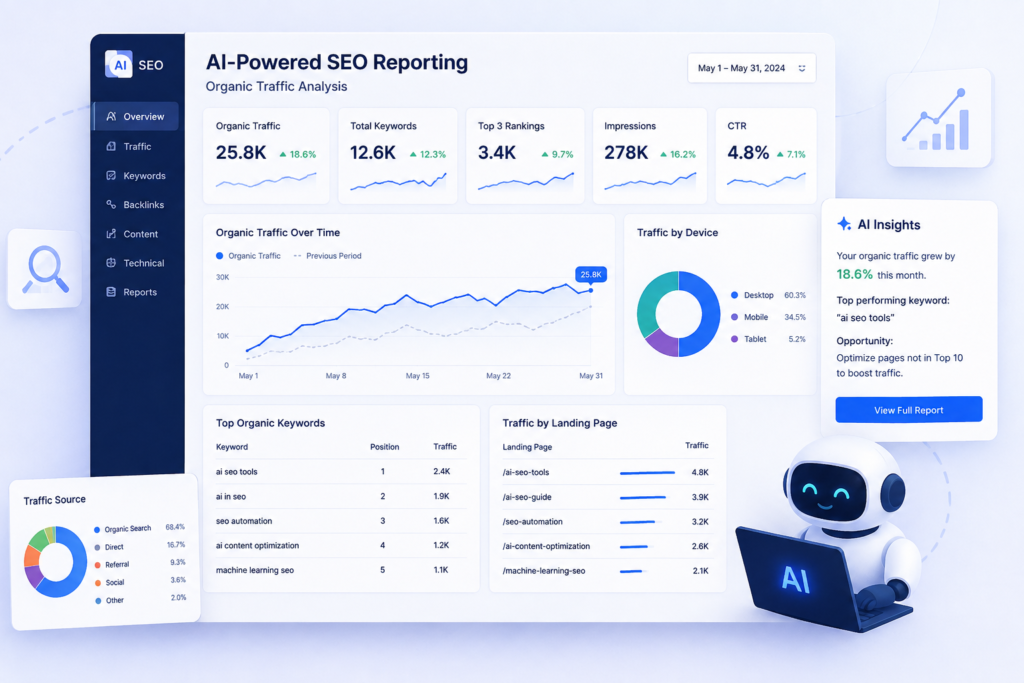
AI in SEO reporting helps transform complex performance data into insights that are easier for marketers and business leaders to understand.
Turning Search Console and Analytics Data Into Actionable Insights
AI platforms excel at pulling raw information from Google Search Console and Google Analytics to highlight what truly matters. These systems filter out noise, allowing you to focus on high-impact metrics that influence your bottom line.
- Automated anomaly detection for sudden drops or spikes.
- Categorization of search queries by intent and performance.
- Integration of multi-channel data for a holistic view.
Identifying Ranking, Traffic, and Conversion Trends
Tracking organic traffic is only the beginning of a robust performance strategy. AI helps you spot long-term patterns that might otherwise remain hidden in daily fluctuations. By identifying these trends early, you can pivot your strategy to capitalize on emerging opportunities.
| Metric | AI Insight | Business Impact |
|---|---|---|
| Rankings | Volatility alerts | Protects revenue |
| Traffic | Growth patterns | Informs content |
| Conversions | Funnel leaks | Improves ROI |
Creating Clear Reports for Marketing Teams and Business Leaders
Effective SEO reporting must speak the language of your audience. Marketing teams often need granular data, while business leaders prefer high-level summaries that connect search performance to revenue goals.
AI tools simplify this by generating visual dashboards that translate technical jargon into business outcomes. This clarity ensures that everyone stays aligned on the value of your search initiatives.
Using Human Analysis to Explain the Reasons Behind Performance Changes
While AI is excellent at spotting changes in organic traffic, it cannot always explain the “why” behind the data. Human expertise remains essential to interpret the context of these shifts.
You must investigate whether a performance change stems from seasonality, recent content updates, or broader market shifts. By combining machine-driven data with human intuition, you provide a complete picture that supports smarter, faster decision-making.
Common Risks and Mistakes When Using AI for SEO
While AI offers incredible speed, it also introduces significant SEO risks that can undermine your hard work. Relying entirely on automation without human intervention often leads to content that fails to resonate with real people or satisfy search engine quality standards.
However, AI in SEO should always be supported by fact-checking, editorial review, and human strategic judgment.
Publishing Inaccurate, Repetitive, or Unoriginal Content
AI models are designed to predict the next likely word, not necessarily the truth. This can lead to hallucinations, where the tool presents false information with total confidence. Furthermore, relying on AI often results in repetitive phrasing that lacks the unique insights your audience craves.
- Always verify technical claims against primary sources.
- Use plagiarism checkers to ensure your content remains original.
- Edit AI drafts to remove redundant sentence structures.
Overlooking Brand Voice and Audience Needs
A major mistake is treating AI output as a finished product. AI often produces a generic, robotic tone that fails to reflect your company’s unique personality. If your content does not speak directly to the pain points of your specific audience, you will struggle to build trust and authority.
“Content is the bridge between your brand and your customer; if the bridge is built by a machine without a soul, the customer will never cross it.”
Relying on Predictions Instead of Verifiable SEO Data
Many AI tools offer suggestions based on patterns rather than real-time performance data. You should never treat these predictions as absolute truths for your strategy. Verifiable data from tools like Google Search Console should always take precedence over AI-generated guesses.
| Risk Factor | Impact on SEO | Mitigation Strategy |
|---|---|---|
| Hallucinations | Loss of E-E-A-T | Fact-check every claim. |
| Generic Tone | Low engagement | Inject brand voice |
| Data Lag | Poor strategy | Use live analytics. |
Protecting Privacy, Copyright, and Sensitive Business Information
When using AI, you must be careful about what data you input into the system. Sharing proprietary strategies or sensitive customer information can lead to data leakage or copyright complications. Always treat your internal business data as confidential and avoid feeding it into public AI models that might store or train on your inputs.
Maintaining a quality-control mindset is the best way to mitigate these SEO risks. By combining the efficiency of AI with the critical judgment of a human expert, you protect your brand, your readers, and your long-term organic visibility.
Building a Practical AI SEO Workflow
Establishing a practical AI SEO workflow is the key to scaling your content efforts without losing quality. By moving from ad hoc experiments to a controlled, repeatable process, you can ensure that technology serves your goals rather than dictating them. This transition requires a clear roadmap that spans from initial data collection to final performance measurement.
Choosing the Right Tasks for Automation
Not every part of your strategy should be automated. The most effective SEO automation focuses on high-volume, repetitive tasks that consume valuable time. For instance, using AI to generate meta descriptions or summarize large datasets allows your team to focus on high-level strategy.
Prioritize tasks that involve data processing or pattern recognition. Leave creative storytelling and complex brand positioning to your human experts. This division of labor ensures that your output remains authentic while your efficiency increases significantly.
Combining AI Tools With SEO Platforms and First-Party Data
To get the best results, you must integrate your AI tools with your existing SEO platforms and internal data. Relying solely on the general knowledge of a language model can lead to generic content. Instead, feed your tools specific insights from your own analytics and keyword research platforms.
When you combine SEO automation with your unique first-party data, the output becomes much more relevant to your specific audience. This approach helps you maintain a competitive edge by grounding your AI-assisted content in real-world performance metrics. It turns a simple tool into a powerful extension of your marketing department.
Creating Review Standards for Accuracy, Quality, and Brand Fit
Even the most advanced tools require human oversight to ensure accuracy and brand alignment. You should establish a formal review process for every piece of content or technical recommendation generated by AI. This standard ensures that your brand voice remains consistent across all channels.
Your review team should check for factual accuracy, tone consistency, and overall value. Never publish content without a final human check. This quality control step is essential for maintaining trust with your readers and search engines alike.
A successful AI in the SEO workflow combines automation with reliable first-party data and clear human review standards.
Measuring Success With Rankings, Qualified Traffic, and Conversions
Success should be measured by outcomes rather than the volume of tasks completed. Focus your reporting on metrics that truly matter to your business, such as improvements in organic traffic and search rankings. These indicators show whether your workflow is actually driving growth.
Ultimately, the goal is to see a direct impact on your bottom line through higher conversion rates. By tracking these KPIs, you can refine your process over time. This data-driven approach ensures that your AI SEO workflow continues to deliver value as your business evolves.
Conclusion
AI in SEO transforms how businesses approach digital growth. When used responsibly, AI in SEO can support research, content refinement, technical analysis, and performance measurement.
True success relies on balancing these tools with human judgment. SEO automation works best when you pair it with reliable data and original expertise. You must always review machine-generated outputs to ensure they align with your brand voice and audience needs.
Responsible use of these systems leads to stronger visibility across search engines. You will find it easier to attract qualified organic traffic by focusing on quality and user intent. Sustainable performance comes from blending smart technology with a deep understanding of your customers.
Start integrating these practices into your daily routine today. Your commitment to high standards will set your website apart in a crowded digital landscape. Keep testing new methods to stay ahead of changing search trends.
FAQ
How does AI in SEO help improve my website’s rankings?
Using artificial intelligence acts as a practical support system for your digital strategy. By leveraging machine learning and natural language processing (NLP), tools like Google Gemini or Claude can analyze vast amounts of data to identify search intent patterns. This allows you to create smarter content and improve research efficiency, helping your site stay competitive in the landscape of modern search in the United States and beyond.
Will AI eventually replace the need for SEO professionals?
Not at all! While AI is an incredible analytical assistant, it cannot replace strategic judgment or human creativity. AI is best used to surface patterns and handle repetitive tasks, but experienced experts are still required to prioritize fixes, ensure EEAT (Experience, Expertise, Authoritativeness, and Trustworthiness), and make final decisions based on unique business goals.
How can I use AI to find better keyword opportunities?
AI moves beyond basic volume metrics by uncovering long-tail searches and conversational queries. You can use it to group related terms into search intent categories, such as informational or transactional. However, it is vital to check AI-generated keyword suggestions against real-world data from reliable platforms like Semrush or Ahrefs before finalizing your targeting.
Can AI assist in creating high-quality content that actually ranks?
Yes, by helping you build detailed outlines, content briefs, and supporting points. Generative AI is excellent for improving content readability and structure. To succeed, you must keep your original expertise at the center of every draft. Fact-checking and adding a unique brand voice are essential to ensure the content remains useful and avoids being flagged as unoriginal by Google’s search algorithms.
What are the benefits of using AI for optimizing existing web pages?
AI can quickly scan your site to find content gaps or outdated information that might be causing a decline in organic traffic. It provides recommendations for strengthening meta descriptions, headings, and internal links. Reviewing these suggestions allows you to refresh underperforming pages and improve your overall organic visibility with much less manual effort.
Is it safe to use AI for technical SEO tasks like crawlability and indexing?
AI is very effective at detecting patterns in crawlability, indexing, and website performance. It can also identify structured data opportunities to help search engines understand your site better. However, technical validation is still a must. You should always have an SEO specialist or developer review AI-recommended changes to ensure they don’t negatively impact the user experience or site rendering.
How does AI improve site architecture and internal linking?
AI tools can discover relevant connections between your pages that you might have missed. This helps in organizing content clusters around core topics and creating descriptive anchor text. By automating the discovery of these links, you build a stronger site architecture that helps both users and search crawlers navigate your content more effectively.
What are the biggest risks of relying too heavily on AI for SEO?
The primary risks include publishing inaccurate or repetitive content and overlooking your specific brand voice. There are also important considerations regarding privacy, copyright, and the protection of sensitive business information. Always treat AI outputs as drafts that require human oversight to ensure they are verifiable and aligned with your audience’s needs.
How can AI make SEO reporting more actionable for business leaders?
AI excels at turning complex data from Google Search Console and Google Analytics into clear insights. It can identify conversion trends and ranking shifts much faster than manual sorting. This allows marketing teams to create reports that focus on business outcomes and qualified organic traffic rather than just a list of disconnected metrics.
How do I build a practical AI SEO workflow for my team?
Start by choosing the right tasks for automation, such as data collection, research, or initial drafting. Combine your AI tools with first-party data and establish strict review standards for quality and brand fit. By measuring success through conversions and rankings, you can create a sustainable process that balances SEO automation with human-led strategy.