
Table of contents
| 01 | Smart Keyword Research | 10 | Mobile-First SEO | 19 | Voice Search |
|---|---|---|---|---|---|
| 02 | Search Intent | 11 | Schema Markup | 20 | Brand SEO |
| 03 | Competitor Analysis | 12 | Image SEO | 21 | CTR Optimization |
| 04 | On-Page SEO | 13 | Video SEO | 22 | User Engagement |
| 05 | Content That Ranks | 14 | Local SEO | 23 | International SEO |
| 06 | Topical Authority | 15 | Quality Backlinks | 24 | User-Generated Content |
| 07 | E-E-A-T | 16 | AI Search & AEO | 25 | Recover Lost Rankings |
| 08 | Technical SEO | 17 | Internal Linking | 26 | SEO Roadmap |
| 09 | Core Web Vitals | 18 | SEO Performance | 27 | Google Algorithm Updates |
Introduction
Top SEO Strategy to Improve Website Ranking in 2026 is no longer about relying on one tactic. It requires a combination of high-quality content, keyword research, technical SEO, strong user experience, and authoritative backlinks to improve visibility and achieve sustainable organic growth.
Search engine optimization (SEO) has never been more dynamic than it is in 2026. With Google’s AI-powered search experiences, evolving ranking systems, and increasing focus on user satisfaction, businesses can no longer rely on outdated tactics such as keyword stuffing or mass backlink building. Instead, successful websites are those that provide genuine value, demonstrate expertise, and deliver an exceptional user experience.
Whether you’re running a personal blog, managing an e-commerce store, or growing a business website, ranking on the first page of Google remains one of the most effective ways to attract high-quality traffic. Organic search visitors are often more engaged, more likely to convert, and more cost-effective than paid advertising over the long term.
The challenge is that SEO is no longer about optimizing a few pages and waiting for results. It now requires a comprehensive strategy that combines high-quality content, technical excellence, user-focused design, and brand authority. Search engines use hundreds of signals to determine which pages deserve top positions, and many of those signals revolve around trust, relevance, and user experience rather than simple keyword matching.
This guide brings together the most effective SEO strategies for 2026. You’ll learn how to research the right keywords, create content that satisfies search intent, optimize your website’s technical performance, build topical authority, leverage AI responsibly, and measure your success using industry-leading tools. By following these strategies, you’ll be better positioned to improve your website’s visibility, increase organic traffic, and achieve sustainable growth in an increasingly competitive digital landscape.
Top SEO Strategy to Improve Website Ranking in 2026: Why SEO Matters
Search behavior has changed dramatically. People now search not only through Google Search but also through AI-powered assistants, voice search, visual search, and conversational platforms. Users expect immediate, accurate, and trustworthy answers.
As a result, search engines prioritize websites that demonstrate expertise, load quickly, work flawlessly on mobile devices, and answer users’ questions comprehensively. SEO is no longer just about visibility—it’s about building trust with both search engines and your audience.
Some of the key benefits of investing in SEO include:
- Consistent organic traffic without paying for every click.
- Increased brand awareness and credibility.
- Higher-quality leads from users actively searching for your products or services.
- Better return on investment compared with many forms of paid advertising.
- Long-term growth through evergreen content.
Unlike paid campaigns, which stop generating traffic when the budget runs out, well-optimized content can continue attracting visitors for months or even years with regular updates.
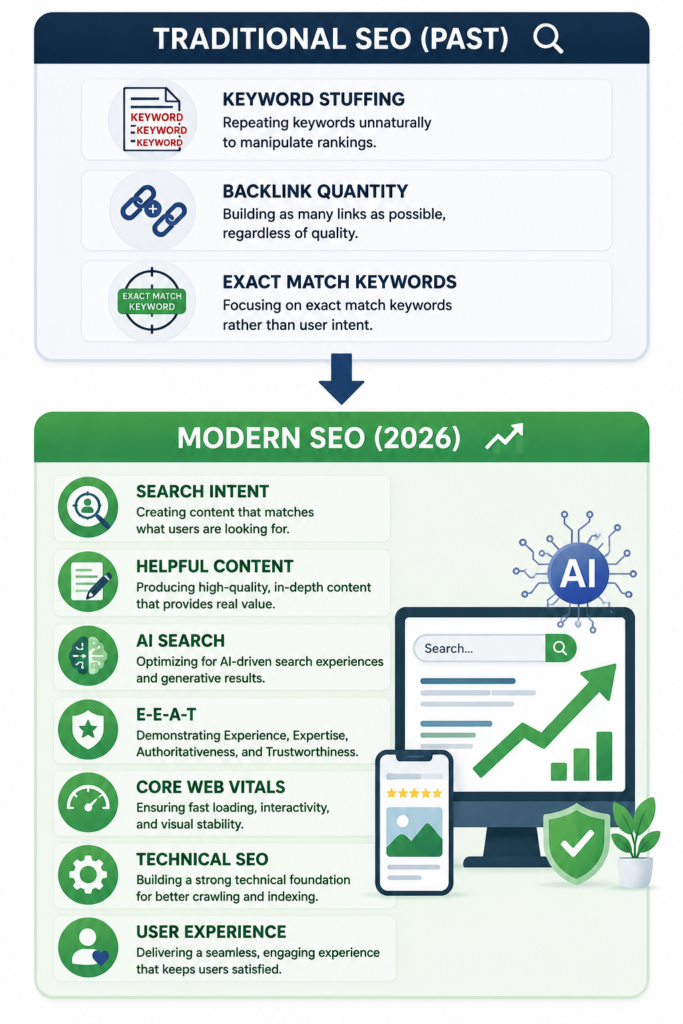
The Evolution of SEO in 2026
| Traditional SEO | AI-Era SEO |
|---|---|
| Keyword-focused | Intent- and context-focused |
| Traditional search results | Search + AI-powered experiences |
| Optimizes individual keywords | Builds topical relevance |
| Primarily targets SERPs | Targets SERPs and AI answers |
| Content optimization | Content + entities + authority |
| Ranking-focused | User-value and visibility-focused |
Understanding Google’s Search Evolution
Google’s ranking systems have become increasingly sophisticated. Rather than focusing solely on keywords, Google evaluates whether a page genuinely satisfies a user’s needs.
Some of the major developments influencing SEO in 2026 include:
AI-Powered Search
Google uses advanced AI models to better understand search queries, identify user intent, and generate richer search experiences. Pages that provide clear, structured, and trustworthy information are more likely to be surfaced.
Helpful Content
Content created primarily to help users—not manipulate search rankings—continues to perform well. Articles should answer questions thoroughly, demonstrate expertise, and avoid unnecessary filler.
Experience, Expertise, Authoritativeness, and Trustworthiness (E-E-A-T)
Google increasingly values content created by people with real-world experience and subject knowledge. Clear author information, accurate references, and transparent business details all contribute to stronger trust signals.
User Experience
Fast-loading pages, intuitive navigation, responsive design, and accessible layouts contribute to both user satisfaction and search performance.
Building a Winning SEO Strategy
Many websites fail because they focus on isolated tactics instead of creating a cohesive SEO strategy.
An effective strategy begins by understanding your audience. Identify the questions they ask, the problems they face, and the information they need at each stage of the customer journey.
Next, define your goals. Are you aiming to generate leads, increase online sales, build brand awareness, or grow newsletter subscriptions? Your SEO approach should align with these objectives.
From there, organize your content into topical clusters. Rather than publishing unrelated articles, create a pillar page supported by several in-depth articles that explore specific subtopics. This structure helps search engines understand your expertise while making it easier for users to navigate your content.
Finally, track your performance regularly. SEO is an ongoing process, and reviewing metrics such as organic traffic, keyword rankings, and conversion rates allows you to refine your strategy over time.
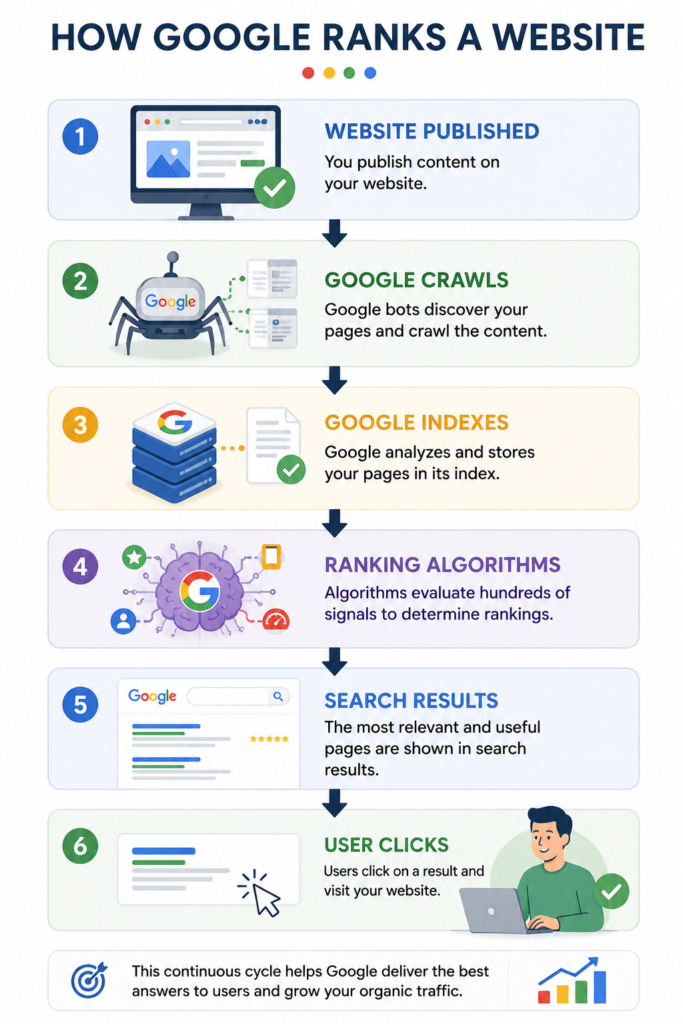
Strategy 1: Conduct Smart Keyword Research
Keyword research remains the foundation of successful SEO, but modern keyword research goes beyond simply finding high-volume search terms.
The goal is to understand what your audience is searching for, why they are searching, and how your content can provide the best possible answer.
Understand Different Types of Keywords
Informational keywords are used by people looking to learn something. Examples include “what is technical SEO” or “how to improve website speed.”
Navigational keywords help users find a specific website or brand.
Commercial investigation keywords indicate that users are comparing options before making a decision.
Transactional keywords show a clear intention to take action, such as making a purchase or requesting a service.
Balancing these keyword types across your content strategy helps attract users at different stages of the buying journey.
Prioritise Search Intent Over Search Volume
A keyword with moderate search volume but strong commercial intent may deliver more valuable traffic than a high-volume keyword with vague intent.
When evaluating keywords, consider:
- Relevance to your business.
- Search intent.
- Competition level.
- Potential to generate leads or sales.
- Opportunity to create unique, valuable content.
Use Modern Keyword Research Tools
Reliable tools include:
- Google Keyword Planner.
- Google Search Console.
- Ahrefs.
- Semrush.
- Moz Keyword Explorer.
- Ubersuggest.
- AnswerThePublic.
- Also Asked.
These tools can help identify keyword opportunities, analyze competition, and uncover questions your audience is asking.
Strategy 2: Optimize for Search Intent
Search intent is one of the strongest ranking factors in modern SEO. Even well-written content may struggle to rank if it doesn’t align with what users expect.
There are four primary types of search intent:
- Informational: Users want to learn something.
- Navigational: Users want to find a specific website.
- Commercial: Users are comparing products or services.
- Transactional: Users are ready to take action.
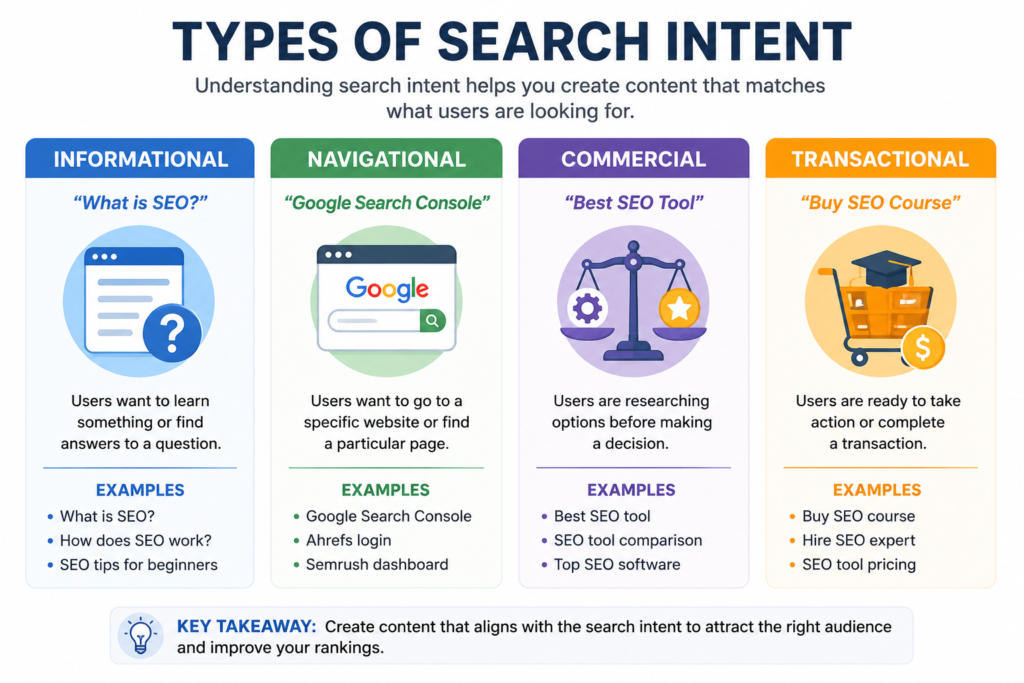
Before creating content, analyze the top-ranking pages for your target keyword. Observe the type of content that appears, the questions being answered, and the level of detail provided. Your goal isn’t to copy those pages but to create a more comprehensive and valuable resource that better satisfies user needs.
For example, if users searching for “top SEO strategies in 2026” expect a detailed guide with actionable tips, publishing a brief 500-word article is unlikely to meet their expectations.
Strategy 3: Conduct Comprehensive Competitor Analysis
One of the fastest ways to improve your website ranking is to learn from competitors already dominating Google’s first page. Competitor analysis helps you identify content gaps, backlink opportunities, keyword targets, and user experience improvements without relying on guesswork.
Remember, the goal isn’t to copy competitors. Instead, understand what makes their content successful and create something more valuable, more comprehensive, and more helpful.
Identify Your SEO Competitors
Your SEO competitors may not always be your business competitors. For example, if you sell SEO services, you might compete with blogs, educational websites, marketing agencies, and software companies for the same keywords.
Search your primary keywords and note the websites consistently appearing on the first page.
Create a spreadsheet with:
- Website name
- Domain Authority
- Number of ranking keywords
- Estimated organic traffic
- Content quality
- Content length
- Backlink profile
- Internal linking strategy
This gives you a clear picture of the competitive landscape.
Analyze Their Top Pages
Most websites generate the majority of their traffic from a small percentage of their pages.
Study their highest-performing content.
Ask yourself:
- What topics are they covering?
- Why is Google ranking these pages?
- Are the articles comprehensive?
- Do they include visuals?
- Are statistics updated?
- Is the page easy to navigate?
- Do they answer related questions?
Instead of writing another “Top SEO Tips” article, aim to create a resource that is more current, better organized, and provides deeper insights.
Perform Keyword Gap Analysis
Keyword gap analysis reveals valuable keywords that competitors rank for but your website does not.
Look for:
- Long-tail keywords
- Question-based searches
- Low-difficulty keywords
- High-conversion commercial keywords
- Featured snippet opportunities
These gaps often represent quick wins, especially for newer websites.
Analyze Competitor Backlinks
Backlinks remain one of Google’s strongest ranking signals.
Review:
- Guest posts
- Resource pages
- Industry directories
- Editorial mentions
- Broken links
- Digital PR campaigns
Focus on earning links from reputable, relevant websites rather than accumulating large numbers of low-quality links.
Evaluate User Experience
Google increasingly rewards websites that provide a smooth and engaging user experience.
Assess competitors’ websites for:
- Page speed
- Mobile responsiveness
- Navigation
- Readability
- Visual design
- Calls to action
- Internal linking
- Accessibility
Use these observations to improve your own site while maintaining your unique brand identity.
| On-Page SEO | Technical SEO | Off-Page SEO |
|---|---|---|
| Content | Crawling | Backlinks |
| Title tags | Indexing | Digital PR |
| Headings | Site speed | Brand mentions |
| Internal links | XML sitemap | Guest contributions |
| Images | Mobile performance | Editorial links |
| Search intent | Structured data | Online authority |
Strategy 4: Master On-Page SEO
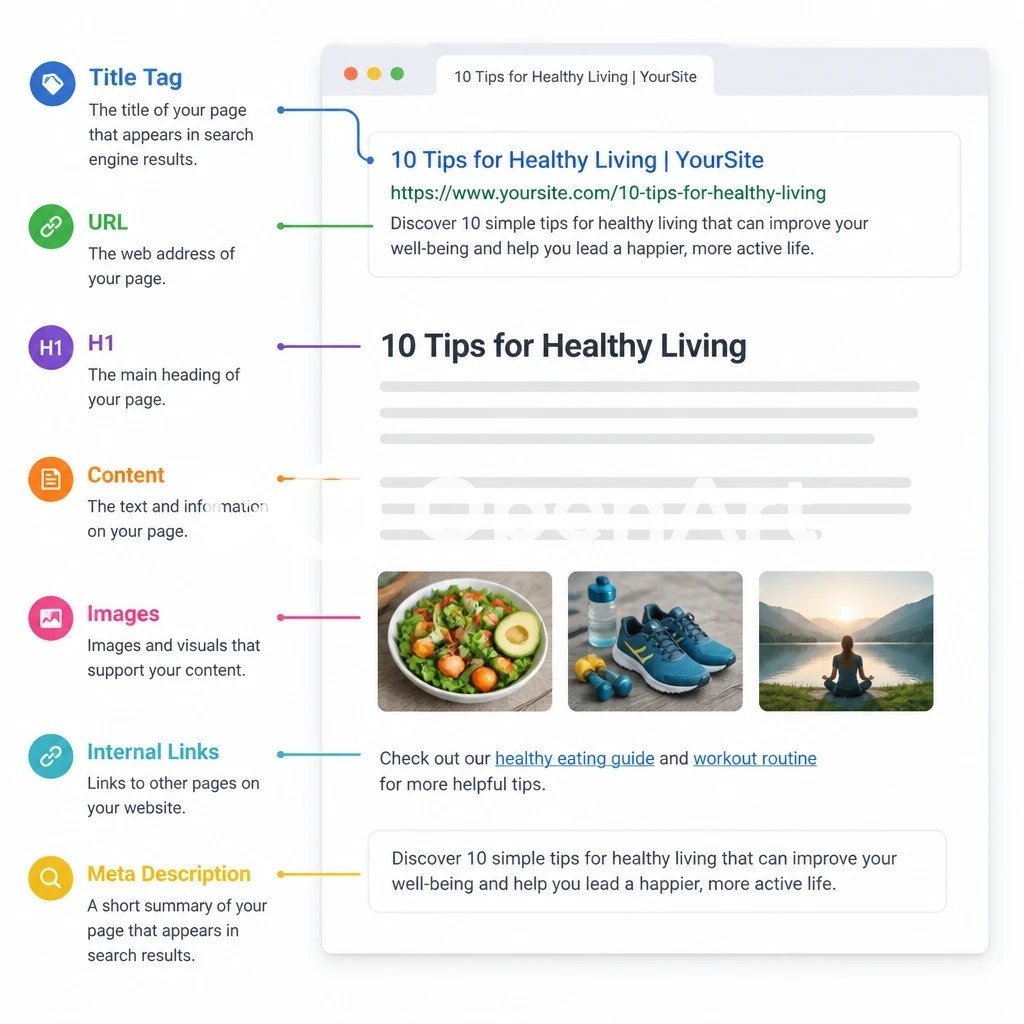
On-page SEO refers to optimizing individual web pages so that search engines can understand their content and users can easily consume it.
Even excellent content may struggle to rank if the page lacks proper optimization.
Optimize Your Title Tag
The title tag is one of the first elements users see in search results.
A good title should:
- Include the primary keyword
- Clearly explain the page topic
- Encourage clicks
- Stay within approximately 60 characters
Example:
Top SEO Strategies to Improve Website Ranking in 2026
This title clearly communicates the topic while including the target keyword naturally.
Write Compelling Meta Descriptions
Although meta descriptions are not a direct ranking factor, they can improve click-through rates.
An effective meta description should:
- Summarize the page
- Include the primary keyword naturally
- Highlight the benefit
- Encourage action
Example:
Learn the most effective SEO strategies for 2026, including AI SEO, keyword research, technical optimization, and link building to increase your website’s organic rankings.
Use One Clear H1 Heading
Each page should contain only one H1 that clearly communicates the main topic.
Use H2 and H3 headings to organize content logically. This improves readability for both users and search engines.
Optimize URLs.
Keep URLs:
- Short
- Descriptive
- Easy to read
- Keyword-focused
Good:
example.com/top-seo-strategies-2026
Poor:
example.com/post?id=28764&page=seo-guide-2026-final
Optimize Images
Images improve engagement, but they should also support SEO.
Best practices include:
- Descriptive file names
- Relevant alt text
- Compressed file sizes
- Modern formats such as WebP
- Responsive sizing
Properly optimized images can also appear in Google Images, bringing additional traffic.
Internal links help users discover related content while allowing search engines to understand relationships between pages.
For example, a guide on SEO strategies could link to articles about the following:
- Keyword research
- Technical SEO
- Link building
- Core Web Vitals
- Content marketing
This creates a stronger topical structure.
Link to Trustworthy Sources
Referencing authoritative resources demonstrates credibility.
When citing statistics or best practices, link to trusted organizations, research studies, or official documentation.
Avoid linking excessively or directing users to unreliable websites.
Strategy 5: Create Content That Deserves to Rank
Publishing more articles doesn’t necessarily improve rankings. Publishing better articles does.
Google increasingly rewards content that demonstrates expertise, answers user questions thoroughly, and provides unique value.
Understand the Helpful Content System
Google evaluates whether content genuinely helps users or simply exists to attract search traffic.
Helpful content typically:
- Solves real problems
- Explains concepts clearly
- Provides examples
- Includes practical advice
- Demonstrates first-hand knowledge
Avoid writing solely to satisfy search engines.
Build Topic Clusters
Instead of publishing isolated articles, organize your content around pillar pages and supporting cluster pages.
Example:
Pillar Page
Top SEO Strategies to Improve Website Ranking in 2026
Supporting articles:
- Keyword Research Guide
- Technical SEO Checklist
- Link-building Strategies
- Core Web Vitals Explained
- Local SEO Guide
- AI SEO Tips
- Schema Markup Guide
This structure strengthens topical authority and improves internal linking.
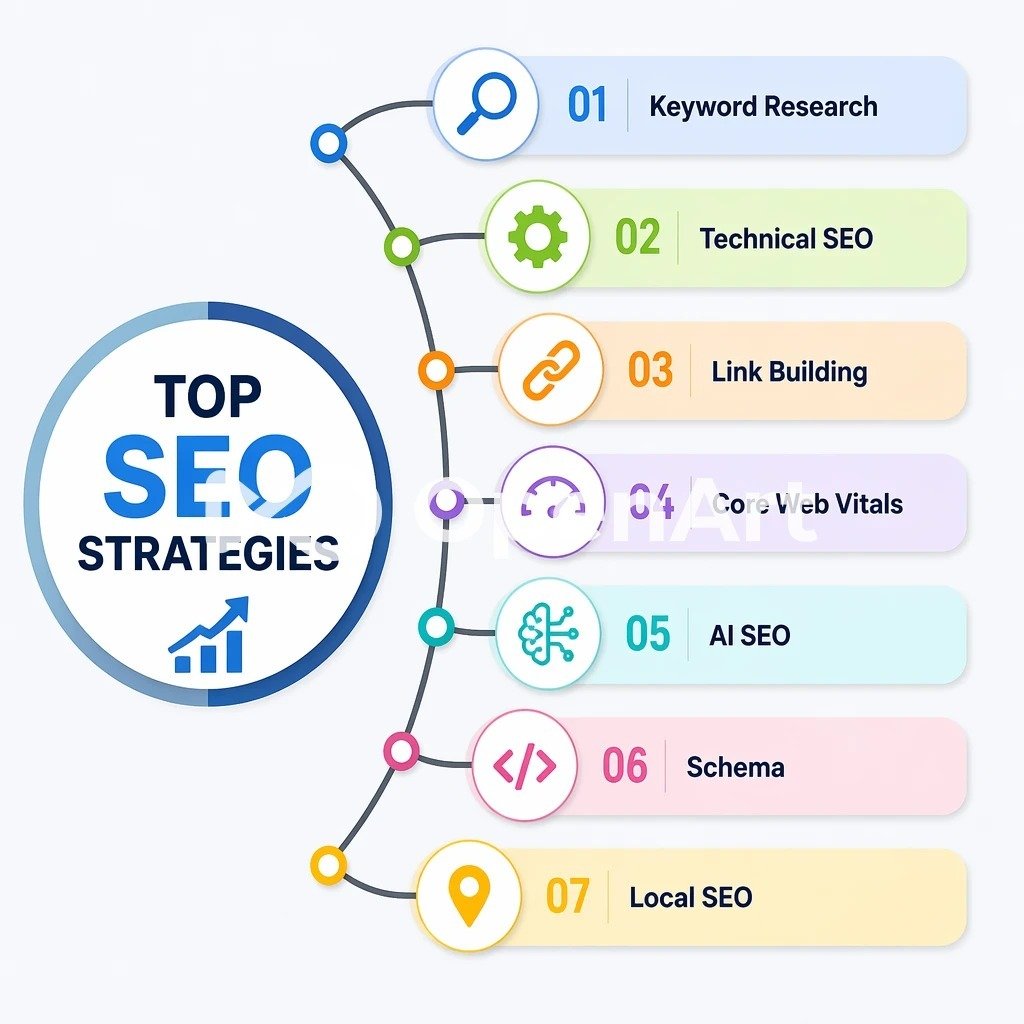
Update Existing Content
Freshness matters for many SEO topics.
Regularly review older articles and:
- Update statistics
- Replace outdated screenshots
- Add new sections
- Improve readability
- Expand thin content
- Remove broken links
Refreshing existing content is often faster than creating entirely new pages.
Improve Readability
Readers scan content before deciding whether to stay.
Make articles easier to consume by:
- Writing short paragraphs
- Using descriptive headings
- Including bullet lists where appropriate
- Adding visuals
- Highlighting important points
- Explaining technical concepts in simple language
A positive reading experience often leads to longer engagement and lower bounce rates.
Strategy 6: Build Topical Authority
Google wants to rank websites recognized as reliable sources on specific subjects.
Rather than writing about dozens of unrelated topics, focus on becoming an expert within your niche.
For example, if your website specializes in digital marketing, create comprehensive coverage of:
- SEO
- Content marketing
- Social media marketing
- PPC
- Email marketing
- AI in marketing
- Analytics
Interconnect these articles with thoughtful internal links to demonstrate the depth of your expertise.
Strategy 7: Strengthen Your E-E-A-T Signals
Google evaluates websites using the principles of experience, expertise, authoritativeness, and trustworthiness.
Although E-E-A-T isn’t a single ranking factor, it influences how Google assesses the quality and reliability of content.
Ways to improve E-E-A-T include:
- Publish detailed author biographies.
- Showcase relevant qualifications or professional experience.
- Cite trustworthy sources for factual claims.
- Keep information accurate and up to date.
- Display clear contact details and business information.
- Use HTTPS to secure your website.
- Encourage genuine customer reviews and testimonials where appropriate.
Trust is especially important for websites covering health, finance, legal advice, or other topics that can significantly affect people’s lives, but it also benefits businesses in every industry.
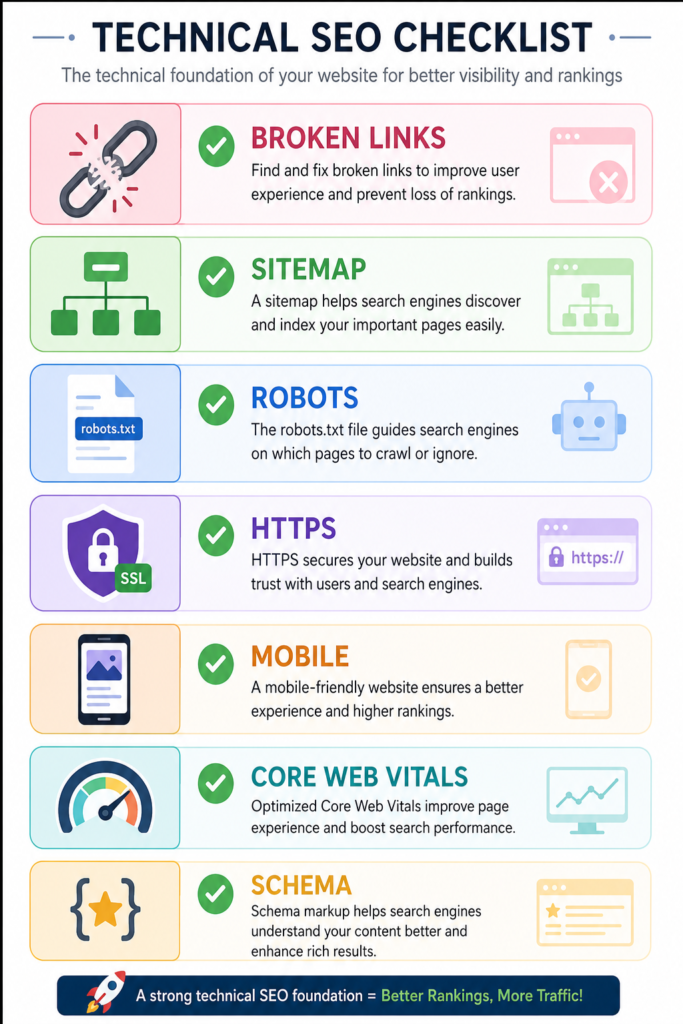
Strategy 8: Build a Strong Technical SEO Foundation
Technical SEO ensures that search engines can discover, crawl, understand, and index your website efficiently. Even the most valuable content may struggle to rank if technical issues prevent search engines from accessing or interpreting it correctly.
Think of technical SEO as the foundation of your website. Without a solid foundation, even excellent content and strong backlinks won’t achieve their full ranking potential.
| Crawling | Indexing | Ranking |
|---|---|---|
| Search engines discover pages. | Search engines process/store eligible pages. | Search engines determine visibility/order. |
| Done by crawlers | Happens after crawling | Happens when a search is performed |
| Links and sitemaps help discovery. | Indexability affects inclusion. | Relevance, quality, and other signals matter. |
| Example: Googlebot visits a URL. | The page is considered for Google’s index. | The page appears in search results. |
Make Your Website Crawlable
Search engines use automated bots, often called crawlers or spiders, to explore websites. If these bots cannot access your pages, your content won’t appear in search results.
To improve crawlability:
- Use a logical site structure.
- Link to important pages internally.
- Avoid orphan pages (pages with no internal links).
- Ensure navigation is simple and intuitive.
- Keep essential pages within three to four clicks from the homepage.
A clear website architecture helps both search engines and users find content more easily.
Optimize Your XML Sitemap
An XML sitemap acts as a roadmap for search engines by listing the important pages on your website.
A well-maintained sitemap should:
- Include only indexable pages.
- Update automatically when new content is published.
- Exclude duplicate or redirected URLs.
- Be submitted through Google Search Console.
While Google can often discover pages through internal links, an XML sitemap improves efficiency and helps ensure that new content is indexed more quickly.
Configure Robots.txt Correctly
The robots.txt file tells search engine crawlers which parts of your website they may or may not access.
Be careful when editing this file. Accidentally blocking important pages can prevent them from appearing in search results.
Common uses include:
- Blocking admin areas.
- Preventing duplicate content from being crawled.
- Allowing search engines to access CSS and JavaScript files needed for rendering.
Use HTTPS.
Website security is a confirmed Google ranking signal.
HTTPS encrypts data transferred between users and your website, protecting sensitive information and increasing trust.
Ensure:
- Every page loads over HTTPS.
- HTTP versions redirect permanently to HTTPS.
- Mixed-content errors are resolved.
Visitors are far more likely to trust websites displaying a secure connection.
Fix Broken Links
Broken links create a poor user experience and waste crawl budget.
Regularly check for:
- 404 errors.
- Broken internal links.
- Broken external links.
- Redirect chains.
Updating or removing broken links improves website quality and makes navigation smoother.
Handle Duplicate Content Properly
Duplicate content can confuse search engines and dilute ranking signals.
Common causes include:
- Multiple URLs displaying the same content.
- Printer-friendly pages.
- HTTP and HTTPS versions.
- URL parameters.
- Category archives.
Where duplicate content is unavoidable, use canonical tags to indicate the preferred version of a page.
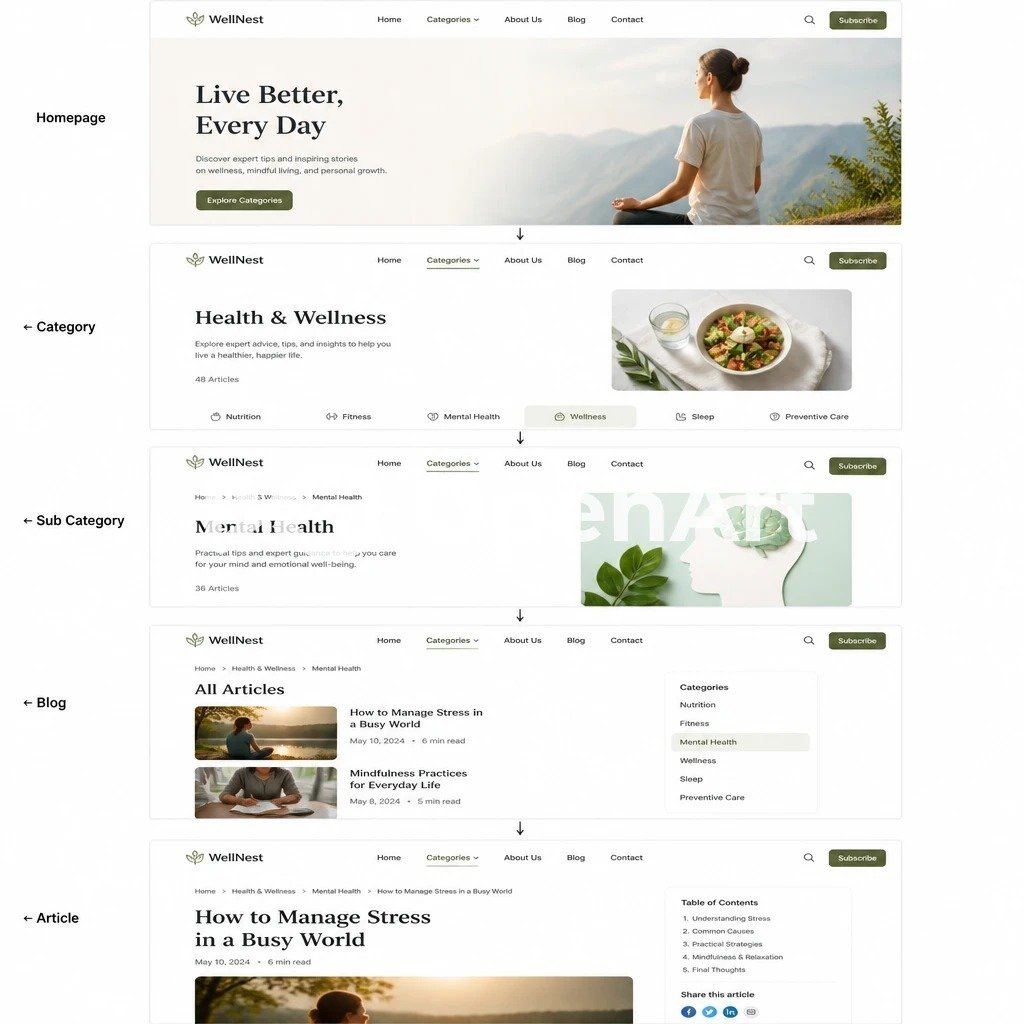
Improve Website Structure
A clean site structure helps visitors navigate your content while enabling search engines to understand topic relationships.
Example structure:
Home
├── SEO
│ ├── Keyword Research
│ ├── Technical SEO
│ ├── Link Building
│ ├── Local SEO
│ └── AI SEO
├── Social Media Marketing
├── Content Marketing
└── Contact
This hierarchy creates logical content relationships that strengthen topical authority.
Strategy 9: Optimize Core Web Vitals
Google uses Core Web Vitals to measure real-world user experience.
These metrics evaluate loading speed, responsiveness, and visual stability.
Although they represent only one part of Google’s ranking systems, improving them benefits both rankings and user satisfaction.
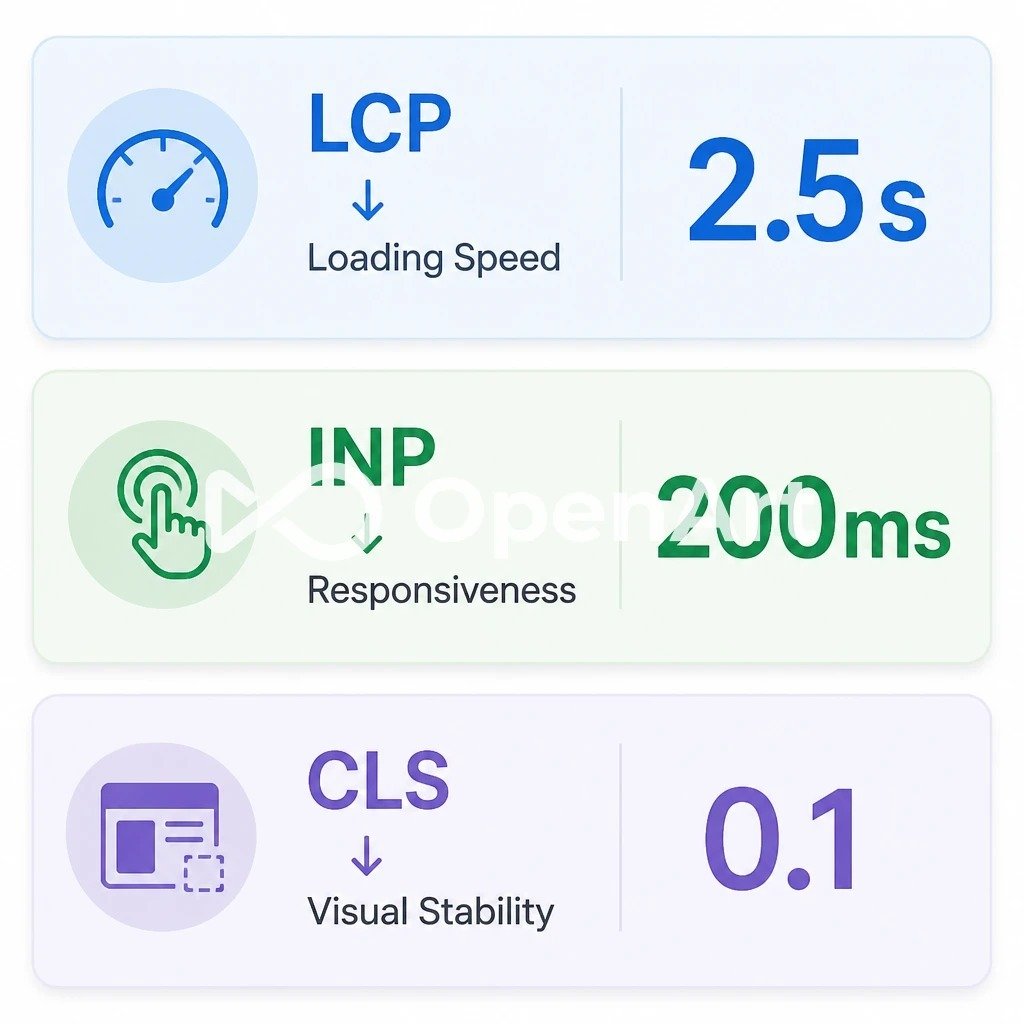
Largest Contentful Paint (LCP)
LCP measures how quickly the main content becomes visible.
Aim for:
Less than 2.5 seconds
Improve LCP by:
- Compressing images.
- Using modern image formats.
- Upgrading hosting.
- Reducing server response time.
- Implementing lazy loading appropriately.
- Removing unnecessary scripts.
Interaction to Next Paint (INP)
INP measures how quickly a page responds to user interactions.
Aim for:
Less than 200 milliseconds
Improve responsiveness by:
- Reducing JavaScript execution.
- Eliminating unnecessary plugins.
- Splitting large JavaScript files.
- Optimizing browser rendering.
Fast interaction creates a smoother browsing experience.
Cumulative Layout Shift (CLS)
CLS measures unexpected movement of page elements while loading.
Aim for:
Below 0.1
Reduce layout shifts by:
- Defining image dimensions.
- Reserving space for advertisements.
- Avoiding dynamically inserted elements above existing content.
- Loading fonts efficiently.
Stable pages reduce frustration and improve usability.
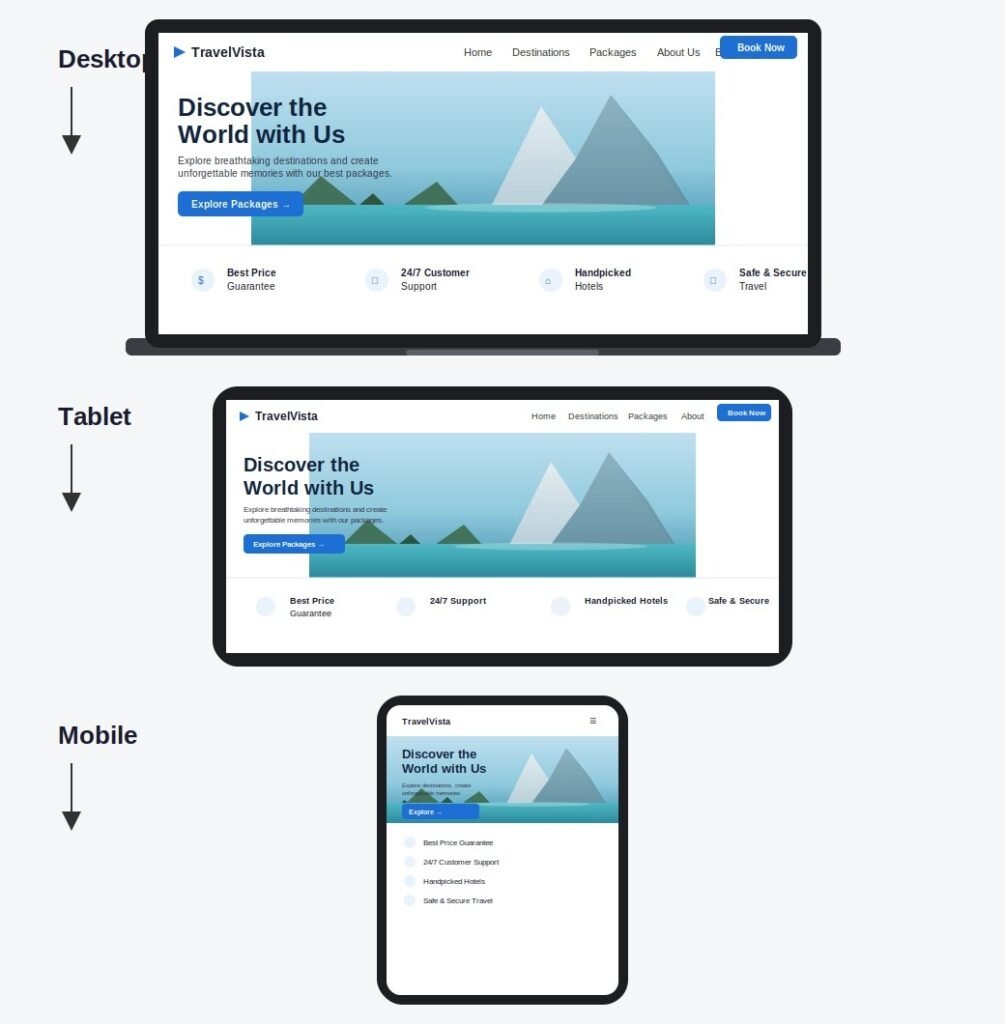
Strategy 10: Optimize for Mobile-First Indexing
Google primarily uses the mobile version of websites for indexing and ranking.
If your mobile experience is poor, your rankings may suffer even if your desktop site performs well.
Use Responsive Design
Responsive websites automatically adapt to different screen sizes.
Benefits include:
- Better usability.
- Easier maintenance.
- Consistent experience across devices.
- Improved SEO.
Avoid maintaining separate mobile websites unless absolutely necessary.
Improve Mobile Navigation
Visitors should easily find what they need.
Best practices include:
- Clear menus.
- Large touch targets.
- Readable fonts.
- Simple layouts.
- Minimal intrusive pop-ups.
Reduce Mobile Load Time
Mobile users often browse on slower connections.
Optimize by:
- Compressing images.
- Minimizing scripts.
- Removing unnecessary animations.
- Using browser caching.
- Implementing a content delivery network (CDN).
Strategy 11: Use Structured Data (Schema Markup)
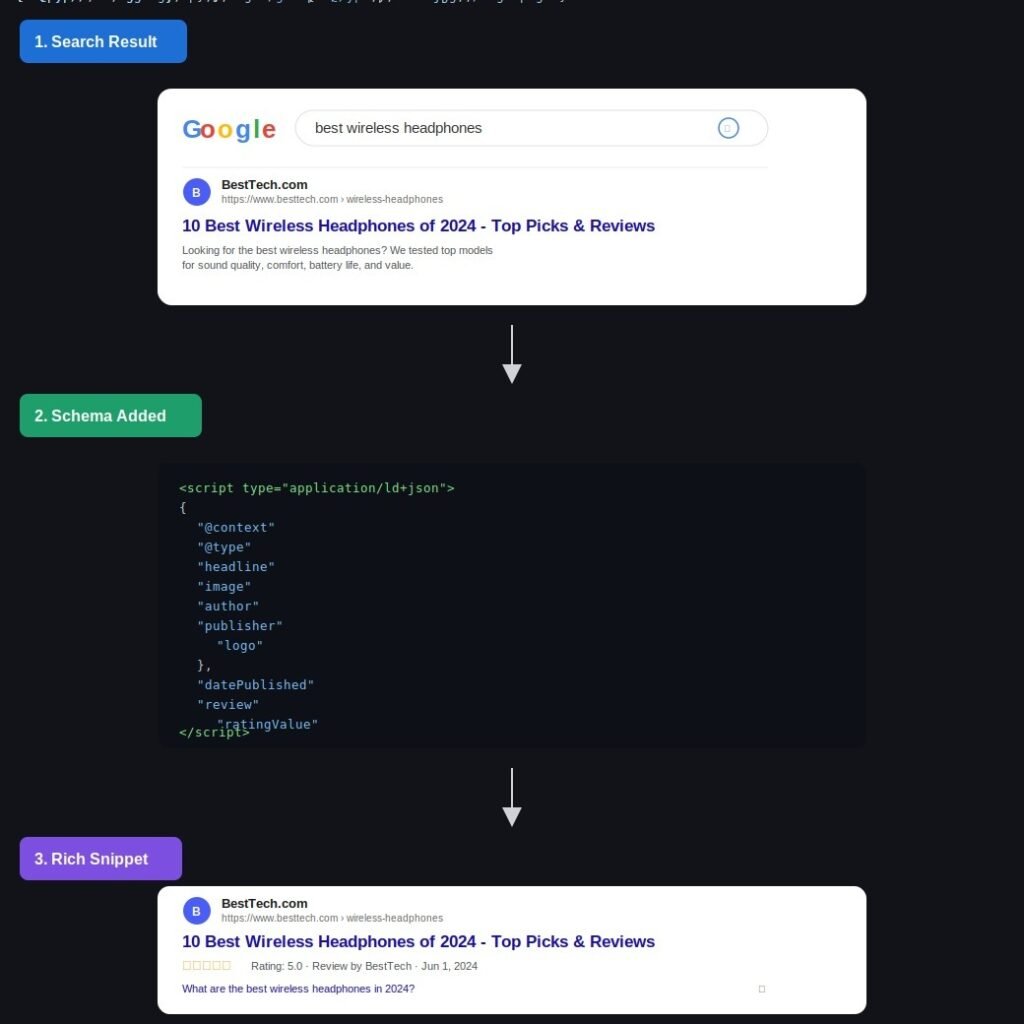
Schema markup helps search engines understand your content more accurately.
Although schema does not directly improve rankings, it can increase visibility through rich results.
Types of Schema
Useful schema types include:
- Article
- FAQ
- Breadcrumb
- Organization
- Local Business
- Product
- Review
- Video
- Event
Adding appropriate schema increases the likelihood of enhanced search listings.
Benefits of Schema
Schema helps search engines:
- Understand page context.
- Display rich snippets.
- Improve click-through rates.
- Connect related entities.
For example, an article with FAQ schema may appear with expandable questions directly in search results.
Strategy 12: Optimize Images for SEO
Images enhance user engagement while creating additional traffic opportunities through image search.
However, large or poorly optimized images can slow down your website.
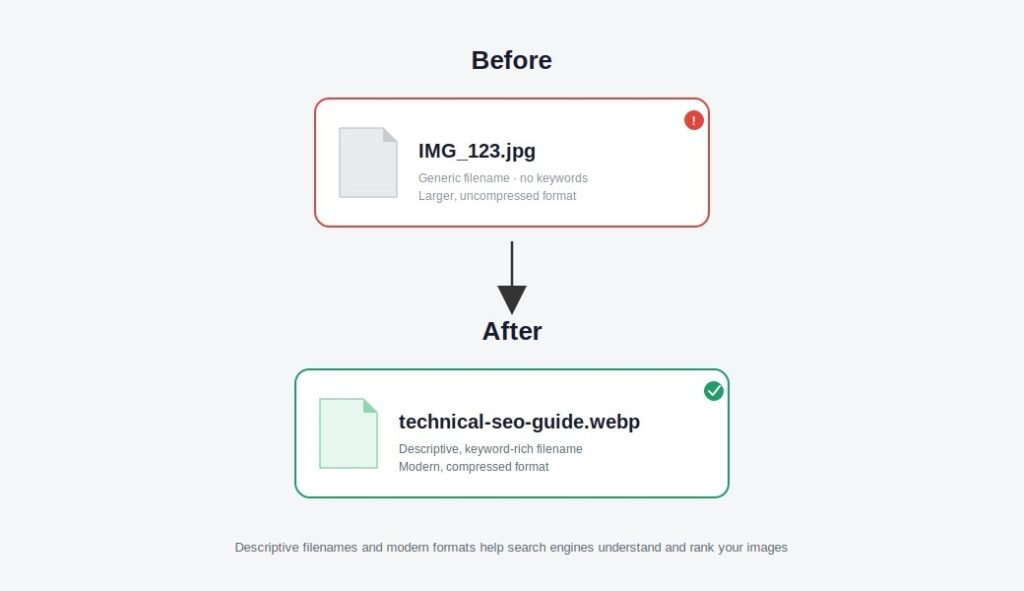
Choose Descriptive File Names
Instead of:
IMG_93821.jpg
Use:
top-seo-strategies-2026.jpg
Descriptive file names provide context before search engines even analyze the image.
Write Meaningful Alt Text
Alt text serves two important purposes:
- Accessibility for visually impaired users.
- Additional context for search engines.
Good example:
“Digital marketer analyzing SEO performance dashboard.”
Poor example:
“Image123”
Compress Images
Large image files increase page loading time.
Use tools that compress images without noticeable quality loss.
Preferred formats:
- WebP
- AVIF
- Optimized JPEG
- PNG where transparency is required
Use Lazy Loading.
Lazy loading delays the loading of off-screen images until users scroll near them.
Benefits include:
- Faster initial page load.
- Lower bandwidth usage.
- Improved Core Web Vitals.
Strategy 13: Video SEO
Video content continues to grow in popularity and can significantly enhance user engagement.
Embedding relevant videos can increase the time users spend on your pages.
Optimize Video Metadata
Include:
- Descriptive titles.
- Keyword-focused descriptions.
- Accurate tags.
- Engaging thumbnails.
- Closed captions.
These elements improve discoverability across search engines and video platforms.
Embed Relevant Videos
Videos should support your written content rather than replace it.
For example:
An article about technical SEO could include a short walkthrough demonstrating how to identify crawl errors using Google Search Console.
Strategy 14: Strengthen Local SEO
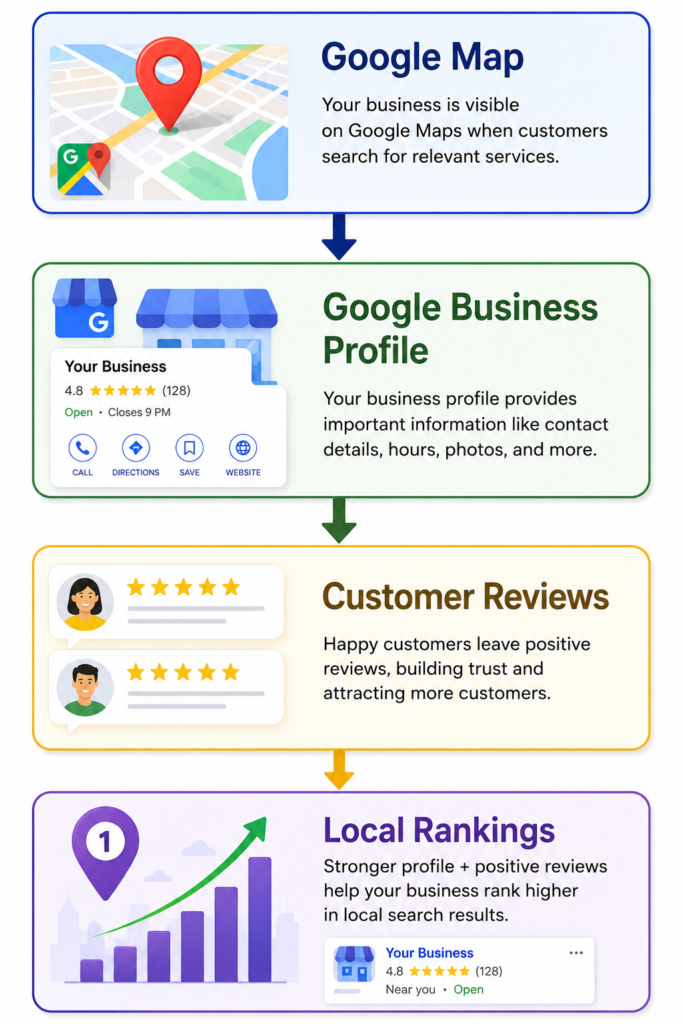
If your business serves a specific geographic area, local SEO should be a priority.
Local search results often appear before traditional organic listings, especially for location-based queries.
Optimize Your Business Profile
Ensure your business information is accurate and consistent.
Include:
- Business name.
- Address.
- Phone number.
- Opening hours.
- Website.
- Business categories.
- High-quality images.
Collect Genuine Reviews
Positive reviews improve credibility and can influence local rankings.
Encourage satisfied customers to leave honest reviews and respond professionally to feedback.
Build Local Citations
List your business consistently across reputable directories.
Ensure your business name, address, and phone number remain identical everywhere they appear.
Create Local Content
Publish articles relevant to your community or service area.
Examples:
- “Best SEO Services in Vadodara”
- “Digital Marketing Trends for Businesses in Gujarat”
- “Local SEO Guide for Small Businesses”
Location-specific content helps search engines understand your geographic relevance.
Strategy 15: Build High-Quality Backlinks
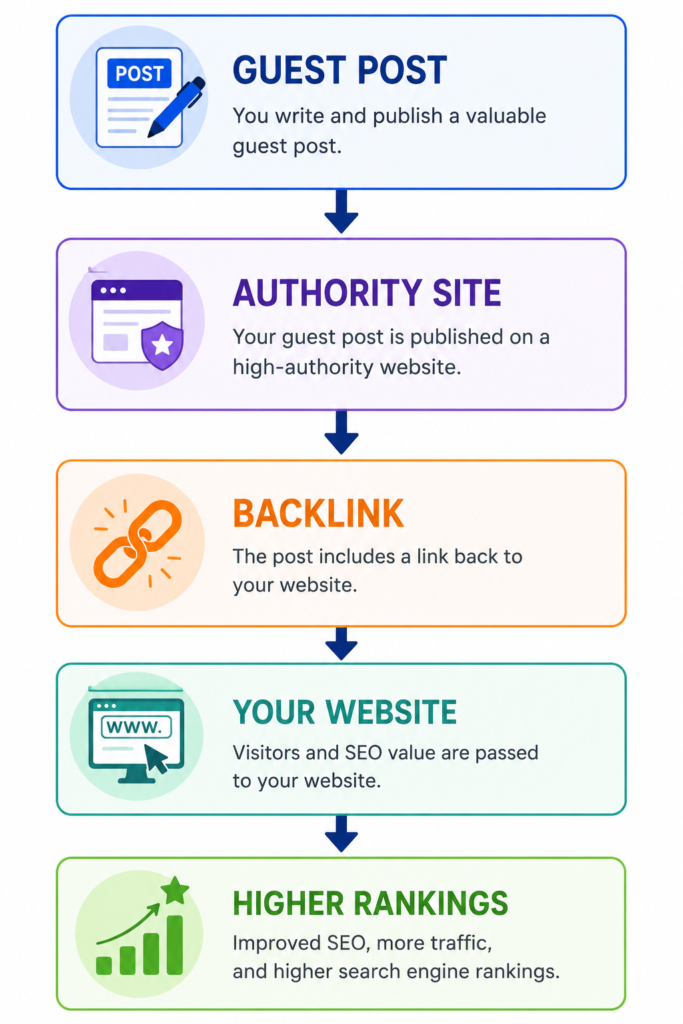
Backlinks remain one of Google’s strongest ranking signals in 2026. However, the emphasis has shifted from acquiring a large number of links to earning high-quality, relevant links from trusted websites.
Think of backlinks as endorsements. When authoritative websites link to your content, search engines view your pages as more trustworthy and valuable.
A single backlink from a respected industry publication can have a greater impact than dozens of links from low-quality websites.
What Makes a High-Quality Backlink?
Not every backlink carries the same value. Search engines evaluate backlinks based on several factors.
A high-quality backlink typically comes from:
- A website relevant to your niche.
- A trusted and authoritative domain.
- A page with valuable content.
- Natural editorial placement.
- Contextually relevant anchor text.
For example, if you publish a detailed SEO guide, receiving a backlink from a respected digital marketing blog is far more valuable than links from unrelated or spammy websites.
Link Building
Create Link-Worthy Content
The best way to earn backlinks is by publishing content that people naturally want to reference.
Examples include:
Comprehensive Guides
Detailed resources covering a topic from start to finish often attract links because they become reliable references.
Original Research
Publishing survey results, case studies, or industry statistics gives other websites a reason to cite your work.
Free Tools
SEO calculators, keyword generators, website audit tools, and templates naturally attract backlinks over time.
Infographics
Well-designed infographics simplify complex information and encourage sharing across blogs and social media.
Expert Roundups
Interviewing experienced professionals adds credibility and often results in participants sharing and linking to your content.
Guest Blogging
Guest blogging remains effective when done strategically.
Focus on websites that:
- Publish high-quality content.
- Are relevant to your industry.
- Have engaged audiences.
- Maintain editorial standards.
Avoid submitting low-quality articles to websites created solely for link building.
Every guest article should provide genuine value to readers.
Broken Link Building
Broken link building is one of the most effective white-hat strategies.
The process involves:
- Finding broken links on relevant websites.
- Creating or identifying similar content on your website.
- Contacting the website owner.
- Suggesting your content as a replacement.
Since you’re helping improve their website, this outreach often receives positive responses.
The Skyscraper Technique
The Skyscraper Technique remains highly effective when executed properly.
The process:
- Find popular content in your niche.
- Analyze why it attracts backlinks.
- Create something significantly better.
- Reach out to websites linking to the original content.
Improvements might include:
- Updated information.
- Better visuals.
- More practical examples.
- Improved readability.
- Additional resources.
- Step-by-step tutorials.
The goal is to create the most valuable resource available on the topic.
Digital PR
Digital PR combines public relations with SEO to earn editorial backlinks.
Examples include:
- Publishing industry reports.
- Sharing unique research.
- Launching innovative campaigns.
- Commenting on industry news.
- Providing expert opinions.
- Creating interactive tools.
Editorial mentions from respected publications can significantly strengthen your website’s authority.
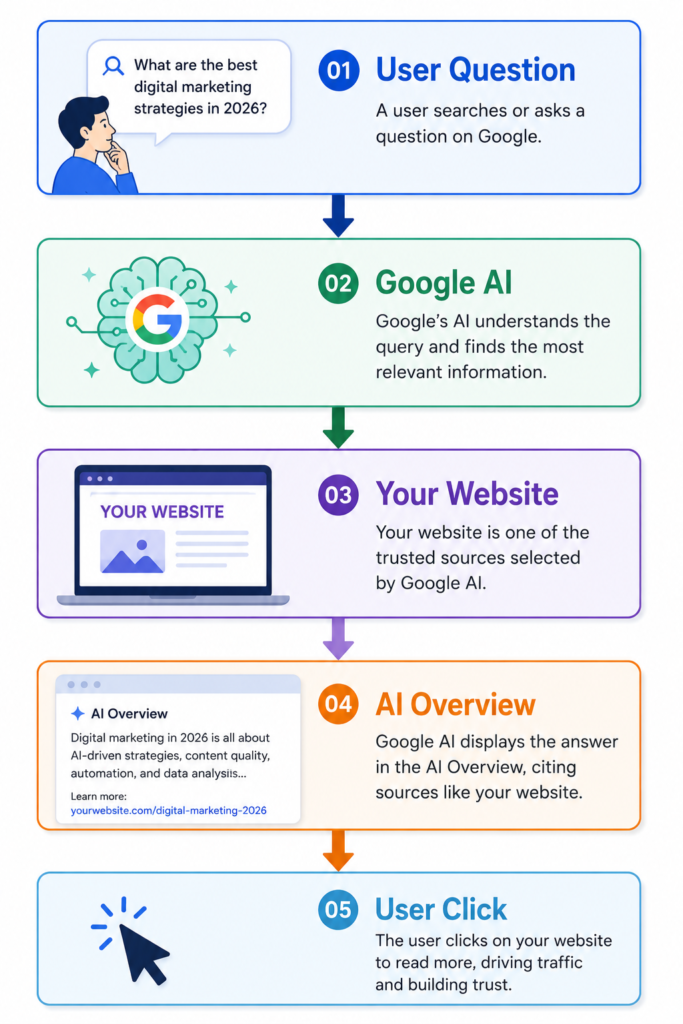
Strategy 16: Optimize for AI Search and Answer Engines
Search is evolving rapidly. Users increasingly receive answers from AI-powered search experiences rather than clicking traditional blue links.
To remain visible, websites must optimize not only for search engines but also for AI-generated responses.
This approach is often called Answer Engine Optimization (AEO).
| SEO | AEO | GEO |
|---|---|---|
| Search Engine Optimization | Answer Engine Optimization | Generative Engine Optimization |
| Focuses on search visibility | Focuses on direct answers | Focuses on visibility in generative AI experiences |
| Targets traditional search | Targets answer-focused experiences | Targets AI-generated responses |
| Uses content, technical SEO, and links | Uses concise answers and structured content | Emphasizes authoritative, useful, and citable information |
| Goal: organic search visibility | Goal: become a useful answer | Goal: be represented in AI-generated results |
Explore in Detail: [AEO] | [GEO]
Write Clear Answers
AI systems favor content that answers questions directly.
Instead of writing lengthy introductions, answer important questions within the first few paragraphs.
Example:
Question
What is technical SEO?
Answer
Technical SEO refers to optimizing a website’s infrastructure so search engines can crawl, index, and understand its pages efficiently.
Clear definitions improve your chances of being featured in AI-generated summaries.
Use question-based headings.
Structure content around real user questions.
Examples:
- What is Technical SEO?
- Why is Page Speed Important?
- How Does Internal Linking Help SEO?
- What Are Core Web Vitals?
This structure aligns with how users interact with conversational search systems.
Organize Content Logically
AI systems interpret structured content more effectively.
Use:
- Clear headings.
- Bullet points.
- Tables.
- Numbered steps.
- Summaries.
- FAQs.
Well-organized pages improve readability for both users and machines.
Demonstrate Expertise
AI-generated search experiences prioritize trustworthy sources.
Strengthen your authority by:
- Publishing accurate information.
- Updating content regularly.
- Including author biographies.
- Referencing reliable sources.
- Sharing practical experience.
Strategy 17: Improve Internal Linking
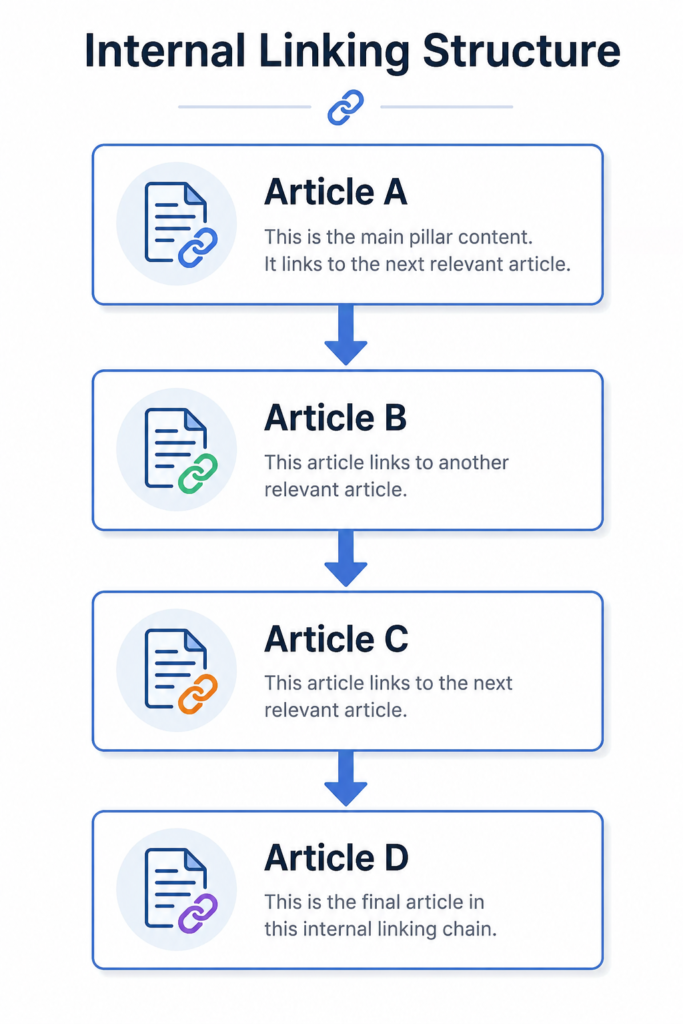
Internal links help search engines understand the relationship between pages while guiding users through your website.
A strong internal linking strategy distributes authority and improves crawlability.
Link Related Content
Whenever appropriate, connect related articles.
Example:
A page discussing keyword research might naturally link to:
- Search intent.
- Content marketing.
- On-page SEO.
- Technical SEO.
- Link building.
These connections create topical clusters that reinforce your expertise.
Use descriptive anchor text.
Anchor text should describe the linked page.
Good example:
Technical SEO checklist
Poor example:
Click here.
Descriptive anchor text provides context for users and search engines.
Avoid Over-Optimization
Internal links should feel natural.
Don’t force dozens of keyword-rich links into every paragraph.
Instead, prioritize links that genuinely help readers explore related topics.
Strategy 18: Measure SEO Performance
SEO success should be measured using meaningful data rather than assumptions.
Tracking performance helps identify opportunities and measure the effectiveness of your strategy.
Key Performance Indicators (KPIs)
Monitor:
- Organic traffic.
- Keyword rankings.
- Click-through rate.
- Impressions.
- Conversions.
- Bounce rate.
- Engagement time.
- Backlinks.
- Indexed pages.
- Returning visitors.
These metrics provide a comprehensive picture of SEO performance.
Use Google Search Console.
Google Search Console offers valuable insights into:
- Search queries.
- Clicks.
- Impressions.
- Average ranking positions.
- Index coverage.
- Mobile usability.
- Core Web Vitals.
- Crawl errors.
Reviewing this data regularly helps identify technical issues and optimization opportunities.
Use Google Analytics 4.
Google Analytics complements Search Console by showing how users interact with your website.
Track:
- Traffic sources.
- User behavior.
- Landing pages.
- Engagement.
- Goal completions.
- Conversions.
Together, these tools provide the data needed to refine your SEO strategy.
Common SEO Mistakes to Avoid
Even experienced marketers make mistakes that limit rankings.
Avoid these common issues:
- Publishing thin content.
- Ignoring search intent.
- Keyword stuffing.
- Buying spammy backlinks.
- Duplicate content.
- Slow page speed.
- Poor mobile experience.
- Broken internal links.
- Outdated information.
- Missing title tags and meta descriptions.
- Neglecting image optimization.
- Forgetting to update old articles.
- Ignoring technical SEO.
Regular audits help identify and resolve these issues before they affect performance.
2026 SEO Checklist
Use this checklist to ensure your website follows modern SEO best practices:
Keyword Research
- Identify primary and secondary keywords.
- Target long-tail and question-based searches.
- Match content with search intent.
Content
- Publish original, comprehensive articles.
- Build topical clusters.
- Refresh outdated content regularly.
- Demonstrate experience and expertise.
On-Page SEO
- Optimize titles and meta descriptions.
- Use proper heading hierarchy.
- Add descriptive alt text.
- Improve readability.
- Link to relevant internal pages.
Technical SEO
- Maintain a clean XML sitemap.
- Configure robots.txt correctly.
- Fix broken links.
- Use HTTPS.
- Resolve duplicate content issues.
Performance
- Improve Core Web Vitals.
- Optimize page speed.
- Ensure mobile responsiveness.
- Compress images.
- Minimize unnecessary scripts.
Authority
- Earn high-quality backlinks.
- Build brand mentions.
- Publish original research.
- Contribute guest articles.
- Strengthen E-E-A-T signals.
Analytics
- Monitor Search Console weekly.
- Review analytics monthly.
- Track keyword rankings.
- Measure conversions.
- Update strategy based on data.
Strategy 19: Optimize for Voice Search
Why Voice Search Matters
Voice searches are usually longer and more conversational than typed queries. Many users ask complete questions using smartphones or smart speakers. Optimizing for these queries helps your content appear for natural-language searches.
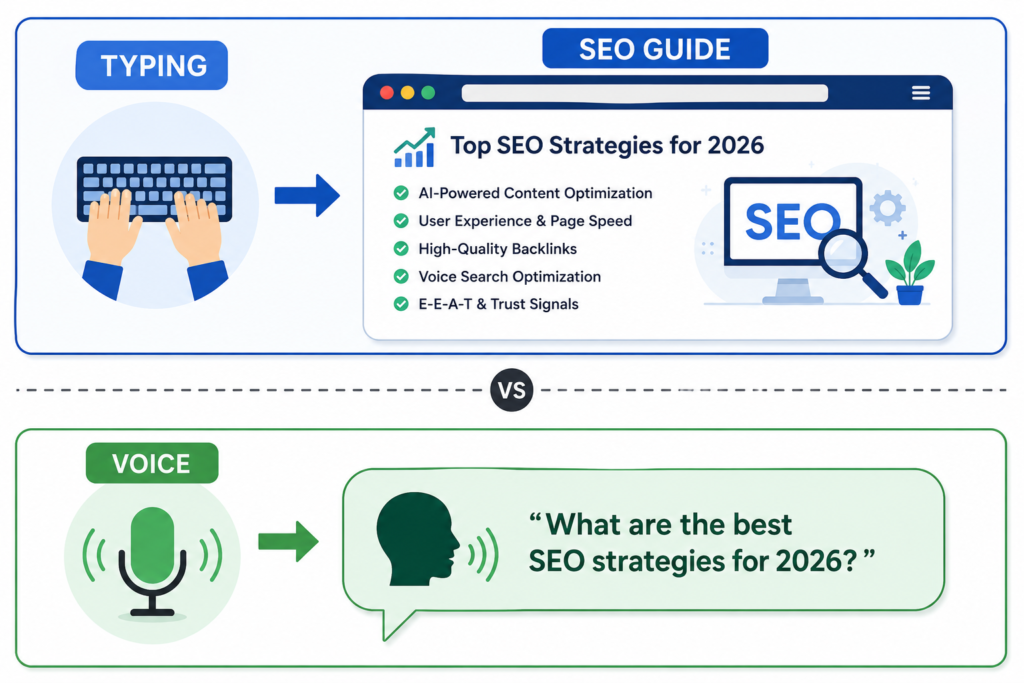
Common Voice Search Examples
Instead of typing:
SEO tools
Users ask:
“What are the best free SEO tools for beginners?”
Instead of typing:
Local SEO
Users ask:
“How can I improve local SEO for my small business?”
Best Practices
- Target long-tail keywords.
- Answer questions naturally.
- Add FAQ sections.
- Use conversational language.
- Optimize for local searches.
- Improve page speed.
- Use structured data.
Example
Instead of targeting:
SEO strategies
Target:
What are the best SEO strategies to improve website ranking in 2026?
Strategy 20: Build a Strong Brand for SEO
Google increasingly rewards recognized and trusted brands.
Why Brand SEO Matters
Google increasingly rewards brands that users recognize and trust. A strong brand can improve click-through rates, increase branded searches, attract natural backlinks, and strengthen your website’s authority.
Ways to strengthen your brand include:
- Publish consistently.
- Create expert-level content.
- Maintain active social media profiles.
- Earn mentions from reputable websites.
- Encourage branded searches.
- Showcase testimonials and case studies.
A strong brand can improve click-through rates and trust, both of which indirectly support SEO.
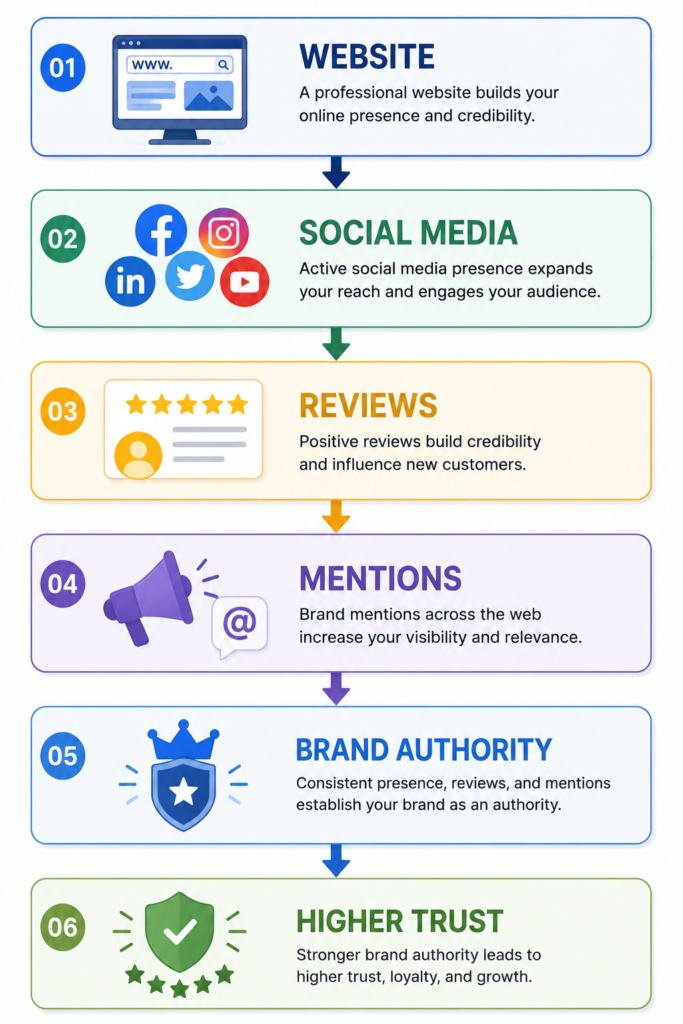
Example
When users search specifically for your brand name, Google interprets this as a trust signal. Over time, strong brand recognition can indirectly support better organic rankings.
Strategy 21: Optimize Click-Through Rate (CTR)
Why CTR Matters
Google measures how users interact with search results. A page that consistently attracts more clicks than competing results may gain additional visibility over time. Writing compelling titles and meta descriptions encourages more users to visit your website.
Higher rankings don’t guarantee more traffic. If users don’t click your result, you miss potential visitors.
Improve CTR by:
- Writing compelling titles.
- Creating engaging meta descriptions.
- Including numbers where relevant.
- Adding the current year.
- Matching user intent.
- Using emotional or benefit-driven language.
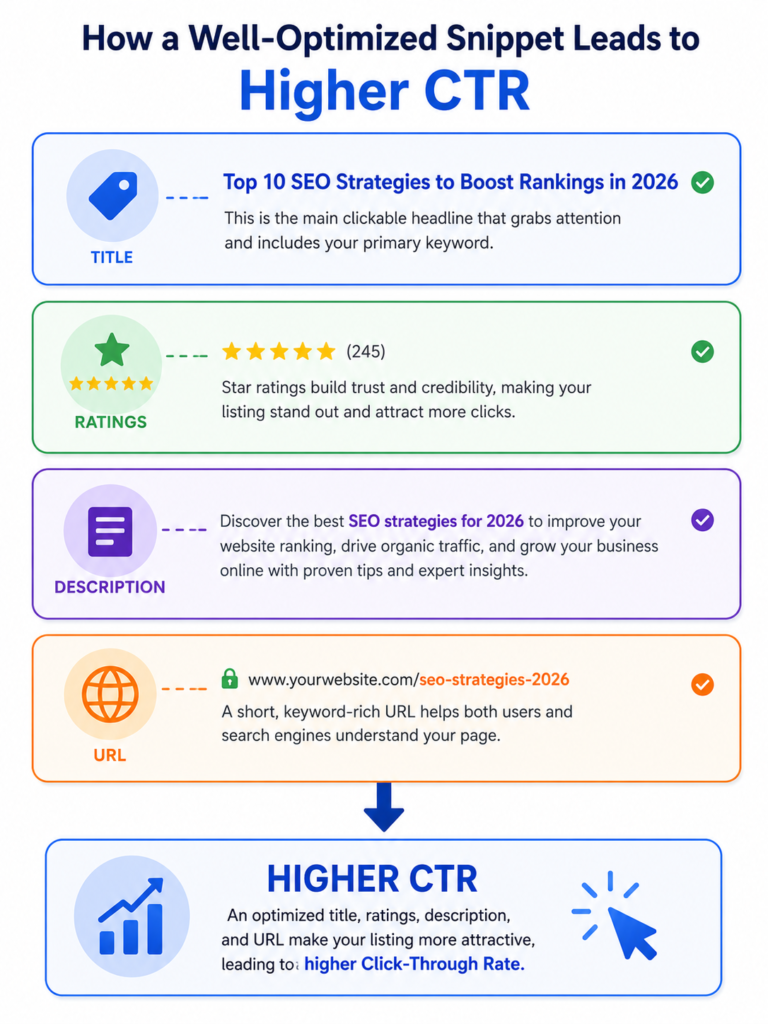
Example
Instead of:
SEO Guide
Use:
Top SEO Strategies to Improve Website Ranking in 2026 (Complete Guide)
Strategy 22: Reduce Bounce Rate and Increase Engagement
Google values positive user engagement.
Ways to keep visitors on your site:
- Add a table of contents.
- Include relevant images and infographics.
- Embed videos.
- Link to related articles.
- Use clear headings.
- Break up long paragraphs.
- Add practical examples.
Engaged visitors are more likely to explore additional content and return in the future.
Example:
A lower bounce rate often indicates that visitors are finding your content useful. While bounce rate itself is not a direct ranking factor, improving user engagement—such as increasing time on page, encouraging deeper navigation, and answering search intent—can positively influence overall SEO performance.
Strategy 23: Optimize for International SEO (If Applicable)
If your website targets multiple countries or languages, international SEO helps search engines serve the correct version of your content.
Key practices include:
- Use hreflang tags.
- Create country-specific URLs when appropriate.
- Localize content, not just translate it.
- Research keywords for each target market.
- Optimize for local search behavior.
Example:
Hreflang tags tell search engines which language or regional version of a page should be shown to different users. This helps prevent duplicate content issues and ensures visitors land on the most relevant version of your website.
Strategy 24: Leverage User-Generated Content
User-generated content can increase freshness and trust.
Examples include:
- Product reviews.
- Testimonials.
- Comments.
- Community discussions.
- Q&A sections.
Moderate content to maintain quality and relevance.
Strategy 25: Recover Lost Rankings
Rankings can decline due to algorithm updates, technical issues, or stronger competition.
Recovery steps:
- Check Google Search Console for errors.
- Compare your page with current top-ranking results.
- Update outdated information.
- Improve content depth and quality.
- Fix technical issues.
- Strengthen internal linking.
- Earn new, relevant backlinks.
Regular monitoring helps identify problems before they significantly impact traffic.
Strategy 26: Create an SEO Roadmap
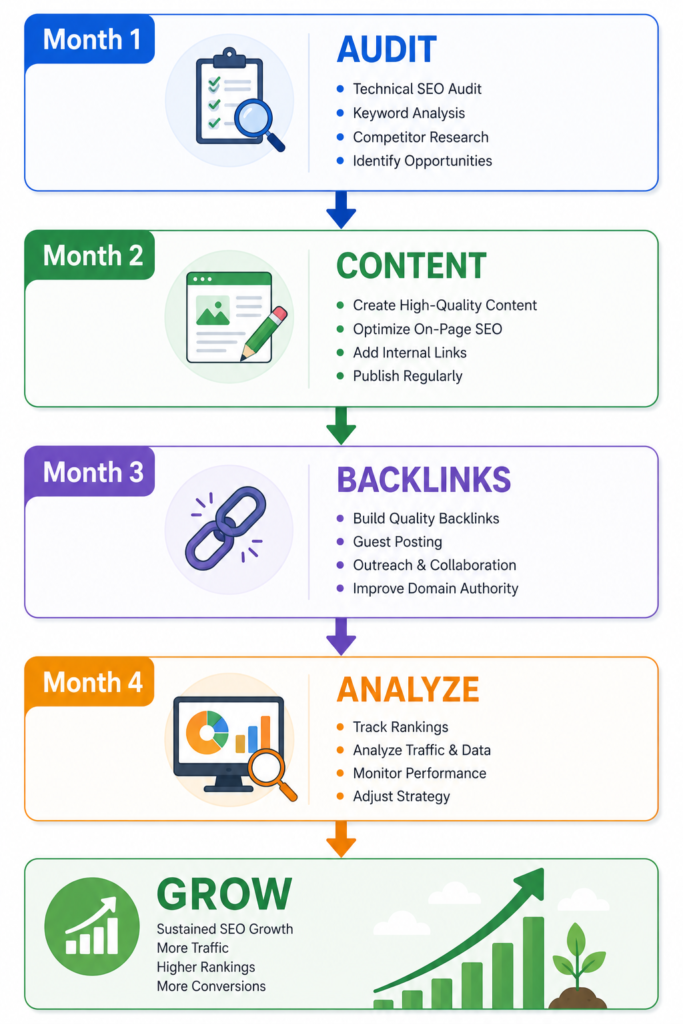
A documented roadmap keeps your efforts organized and measurable.
Month 1
- Perform a full SEO audit.
- Fix technical issues.
- Research keywords.
Month 2
- Publish pillar content.
- Create topic clusters.
- Optimize existing pages.
Month 3
- Begin link-building outreach.
- Refresh older articles.
- Monitor rankings and Core Web Vitals.
Continue reviewing performance monthly and adjust priorities based on analytics.
Strategy 27: Stay Updated with Google’s Algorithm Changes
SEO evolves constantly. Google releases core updates throughout the year that can affect rankings across industries. Rather than chasing every algorithm change, focus on creating helpful content, maintaining technical excellence, and providing a strong user experience.
Best Practices
- Follow Google’s Search Central guidance.
- Monitor Google Search Console after core updates.
- Update outdated articles regularly.
- Improve pages that lose traffic.
- Focus on long-term quality instead of short-term tricks.
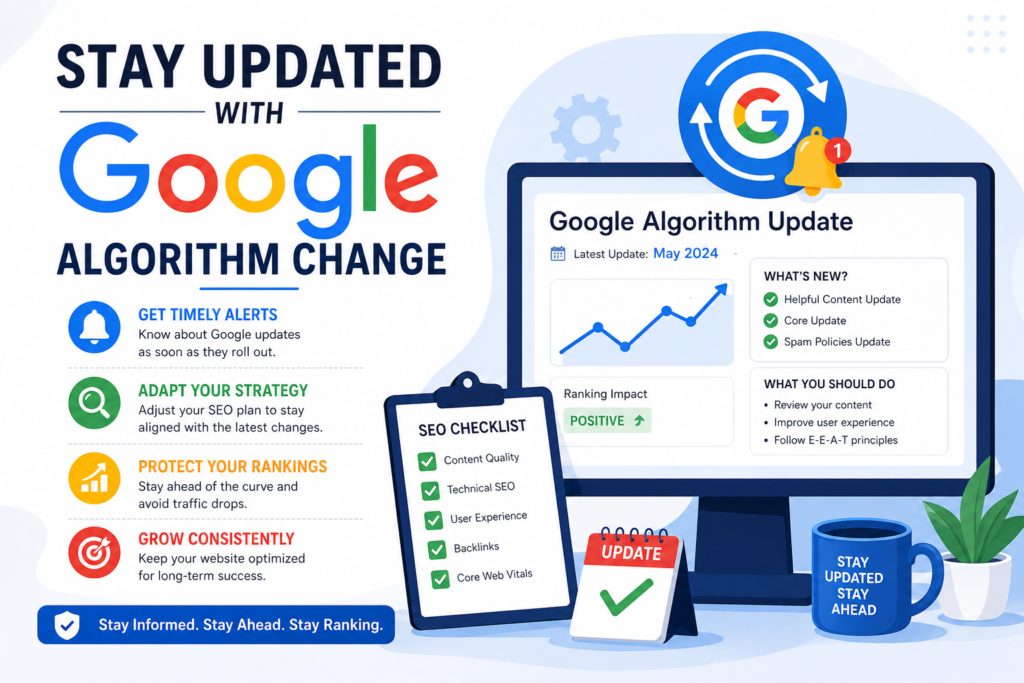
Staying informed about Google’s algorithm updates allows you to adapt your SEO strategy proactively. Instead of reacting to every change, focus on maintaining high-quality content, strong technical performance, and a positive user experience. These long-term best practices remain effective regardless of individual algorithm updates.
Frequently Asked Questions
How long does SEO take to show results?
SEO is a long-term strategy. Many websites begin seeing measurable improvements within three to six months, while highly competitive industries may require six to twelve months or longer. Results depend on factors such as website age, competition, content quality, technical health, and backlink profile.
Is AI replacing SEO?
No. AI is transforming how people search and how content is discovered, but it does not replace SEO. Instead, successful optimization now includes creating content that performs well in both traditional search results and AI-powered search experiences.
Are backlinks still important?
Yes. High-quality backlinks remain one of the strongest signals of authority. Focus on earning relevant, editorial links rather than acquiring large numbers of low-quality backlinks.
How often should I update my content?
Review important pages every six to twelve months. Update statistics, examples, screenshots, and recommendations to ensure information remains accurate and relevant.
Is technical SEO necessary for small websites?
Absolutely. Even small websites benefit from fast loading speeds, proper indexing, mobile optimization, and a clear site structure. A strong technical foundation helps search engines crawl and rank your content more effectively.
Expert Tip: Don’t try to implement every SEO strategy in a single week. Start with technical SEO and keyword research, then create high-quality content, improve internal linking, and finally focus on earning backlinks. Consistent improvement produces better long-term results than making many changes at once.
Conclusion
The top SEO strategy to improve website ranking in 2026 is to build a complete, user-focused approach that combines valuable content, technical excellence, search intent, internal linking, and long-term authority.
. The most successful websites combine valuable content, technical excellence, strong topical authority, trustworthy branding, and a deep understanding of search intent. By implementing the strategies covered in this guide—from smart keyword research and on-page optimization to AI search readiness, high-quality link building, and continuous performance tracking—you’ll be well positioned to improve your website’s rankings and build sustainable organic growth.
Rather than trying to implement everything at once, prioritize the areas that will have the greatest impact on your website. Conduct regular SEO audits, monitor your analytics, update your content consistently, and adapt as search technology evolves. SEO is an ongoing process, but with patience, consistency, and a user-first mindset, it remains one of the most effective ways to grow your online presence in 2026 and beyond.
SEO success doesn’t happen overnight. It comes from consistently publishing valuable content, improving your website’s technical health, earning trust through quality backlinks, and adapting to changing search trends. By implementing the strategies outlined in this guide, you’ll build a stronger online presence, attract more qualified visitors, and position your website for sustainable growth throughout 2026 and beyond.
Further Resources
- Google’s SEO Starter Guide
- Google Search Central Documentation
- Google Search Console Help
- Google Analytics Academy
- PageSpeed Insights
- Lighthouse
- Schema.org
- Ahrefs Learning Hub
- Semrush Academy
- Moz Beginner’s Guide to SEO